
LDX3 New York video hub
All the videos from our New York events
LDX3 New York 2026 videos
-

The state of the software engineering industry
A candid view on where software and AI engineering are heading, what the signals actually suggest, and what it means for teams and careers.
-

Reclaiming the edge: High-performance leadership in a shifting market
How to conduct a ruthless self-assessment, build the right relationships, and take command of your own leadership development at the Director+ level.
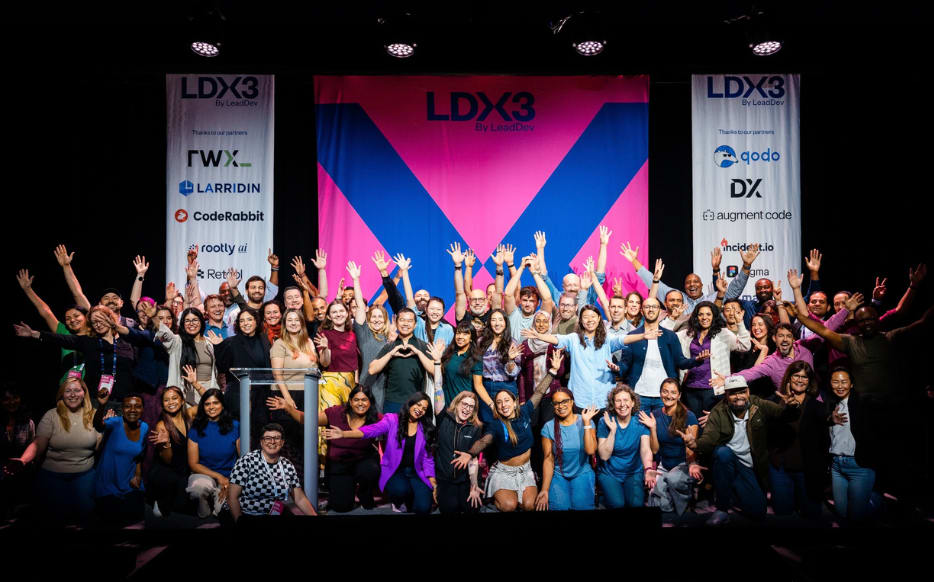
New York • September 8 & 9, 2027
Loved LDX3 New York? Pre-sale tickets for 2027 are now available.
-
Re-engineering the software development playbook
How AI is shifting bottlenecks upstream as implementation costs near zero, and what that means for planning, communication, and where engineering expertise now sits.
-
114 miles to the final cut
How Walter Murch edited a major motion picture on a $999 tool nobody believed in, and what that approach offers anyone trying to lead through a wave of technological disruption.
-
What handcrafted servers taught us about handcrafted code
Whether AI-generated code should be treated as disposable, what the shift to immutable infrastructure taught us, and how those lessons apply to the way teams write and maintain code today.
-

Honing the right engineering skills in the age of AI
How to design work, coaching, and expectations so engineers grow in the areas where human judgment still outperforms AI.
-

Learning to see: Visualising the systems that drive your team
Visualization techniques (scatter plots, value stream maps, investment reports) that reveal where your team’s work is actually getting stuck before you try to fix it.
-

Ms. Frizzle would be a great SRE
Five frameworks from a century of education research that map directly to eval design for AI agents, and why building the eval system before the product changes everything.
-

Protecting innovation under pressure: A practical loop for product and engineering teams
The specific leadership moves that work when you’re managing a crisis with no prior relationships, no system context, and a hard deadline, and why crisis leadership requires a different playbook entirely.
-

Cold start crisis leadership
The specific leadership moves that work when you’re managing a crisis with no prior relationships, no system context, and a hard deadline, and why crisis leadership requires a different playbook entirely.
-
The 30 minute MBA for engineering leaders
The business fundamentals that help engineering leaders understand the financial and commercial forces that shape their work, and engage as partners rather than order-takers.
-

I thought my team knew what mattered
Why people don’t build connection to their work from what you say at all-hands, and how to translate what matters into something that sticks week to week.
-
Your Slack has a neurotypical bias
The communication habits that place disproportionate cognitive load on neurodivergent engineers, and a one-sprint audit with three specific rewrites you can deploy immediately.
-
Tackling the junior developer crisis in the age of AI
How to keep AI in the workflow without losing the apprenticeship: three exercises that rebuild debugging, explanation, and critical thinking when polished output hides shallow understanding.
-
The state of AI in software development: Insights across 500+ organizations
In this talk, Justin Reock, Deputy CTO at DX, will share a data-driven “state of the union” on AI in engineering, grounded in both quantitative data from thousands of developers and on-the-ground observations.
-
The manager’s path in the age of AI
Which management skills AI is genuinely changing, which stay non-negotiable, and how to tell the difference.
-
From SDLC to AI-DLC: Changing how software is built
AI agents may be making code faster to write, but they’re also shifting the bottleneck further down the delivery process. This talk explores why proven practices like progressive rollout, observability, feature flags, and automated rollback are becoming essential for teams adopting AI at scale.
-
How we migrated from manual deploys to agent-driven development in under six months
This talk will dig into the technical and social details of Imprint’s migration to safely transition from manual deploys to continuous deployment with substantial agent-written PRs in under six months.
-
The continuous thunderdome
This talk takes Steve Yegge’s “continuous thunderdome” as a starting point and shows how to make CI/CD work at planet scale, and how to solve the perennial problem that nobody wants to fix the build.
-

Startup made, enterprise grade: Earning trust, scoping tight, and shipping quality with a small team
Small teams are increasingly expected to build for enterprise-scale customers, and AI is changing how they get there. This talk explores how startups can ship enterprise-ready features with lean teams, what’s changed along the way, and how they’re adapting for what comes next.
-
Obsessing over AI is optional
This talk is for overwhelmed engineering leaders and senior ICs who feel quietly guilty about not experimenting with every AI trend.
-

The data canary: How Netflix validates catalog metadata
This talk tells the story of how we built the Data Canary: an automated system that validates data transformations using real production traffic, detects regressions in 2.5–4 minutes, and blocks bad data from publishing, all within a 10-minute window.
-

The real impact of AI on software engineering
This session presents the key findings from LeadDev’s AI Impact Report 2026 – and the numbers tell a more complicated story than the productivity anecdotes suggest.
-

One shot at scale: Surviving the Super Bowl signup surge
This talk goes behind the scenes of how Fetch prepared for a massive Super Bowl traffic spike, scaling from around 1 signup per second to a target of 150,000. It explores the engineering decisions, architectural trade-offs, stress testing, and launch-day processes that helped the team manage risk when there was only one chance to get it right.
-

The accountability gap: Engineering governance for autonomous AI
This session walks through an engineering framework for accountable autonomy: a three-tier trust model that categorizes decisions by blast radius (impact and reversibility), an autonomy budget that meters agent trust with SLOs and revokes it automatically when behavior degrades, and circuit breakers that freeze an agent before a bad pattern becomes an incident.
-

Evaluating AI developer tools without the drama
This talk explores how to turn a divided technical evaluation into a decision everyone can trust. Through a real-world AI code review tool rollout, you’ll learn a practical framework for setting shared criteria, rebuilding developer confidence, and making technical decisions with genuine stakeholder buy-in.
-

How to kill the code review
This talk explores why traditional code review is struggling to keep up with AI-driven development. It introduces a five-layer trust model designed to help engineering teams validate AI-generated code, reduce reliance on manual review, and ship faster without sacrificing quality or control.
-

Building trustworthy agents at scale
This talk explores that journey: how we built testing pipelines for non-deterministic systems, defined “ethical success criteria,” and aligned engineers, product managers, and legal teams around shared principles for responsible AI.
-

Legacy as leverage: How brownfield work builds technical judgment
In this talk, I’ll share how brownfield work builds engineering judgment in ways greenfield environments often do not.
-

You’re already building a software factory
This session will give you a blueprint for building out your team’s factory, both technically and organizationally.
-

Beyond CI/CD: How platform abstractions unlocked developer productivity at scale
In this talk, I will share how our platform engineering team made a deliberate investment to simplify service-to-service connectivity by introducing uniform platform abstractions and out-of-the-box discovery.
-

The first rung: Where the next generation of engineers will come from
A look at how apprenticeship can help engineering leaders develop the next generation of technical talent for an AI-enabled world.
-

AI-native development: How to actually get the most out of your agents
This talk covers spec-driven development as a way to give agents better constraints, large language model (LLM) gateway and routing strategies for managing which model handles which task, test-driven development adapted for an agent-first workflow, and verification practices built for the volume and pace of AI-generated code.


2027 pre-sale tickets are live!
Join the conversations next year. Book now to secure the lowest price.
New York • September 8 & 9, 2027
Videos from previous years of LeadDev New York
-

Supply chain: Data infrastructure pipeline
Discover how modern data pipelines transform supply chains, enabling real-time insights, improving data quality, and optimizing logistics through advanced analytics.
-
Beyond the code: Leading engineering teams in the GenAI era
Explore how engineering leaders can guide teams through GenAI’s rise by focusing on the critical human work AI can’t replace.
-

No One Left Behind: Inside the Largest Domain Migration
A look at the industry’s most complex domain transfer, managed under pressure without losing a single team member.
-
All the things I misunderstood about being a leader
Candid insights into the biggest misconceptions about leadership and what truly makes a team exceptional.
-

How low (level) can you go
Learn how mastering low-level systems and components can make you the go-to engineer for tough problems and drive product success.
-

Unconventional paths in tech: Leveraging your strengths to find your place
n this talk, Mitra Raman will take a look at the many paths that engineers can take on their leadership journey.
-

Making what you have enough: Navigating the realities of the non-boom market
Discover essential tools for navigating uncertainty in the current non-boom market, focusing on resource optimization, prioritization, and supporting individual team members for collective success.
-

You don’t understand how trust works
Explore how to cultivate genuine trust between managers and teams, empowering collaboration and resilience through empathy, active listening, and shared responsibility for greater organizational success.
-

Finding balance: How to build processes that help not hurt your engineering team
Learn how to implement effective processes that empower engineering teams, balancing flexibility and adaptability to foster ownership, accountability, and a positive team culture.
-

Transforming legacy software: Riding the rollercoaster of emotion and innovation
This talk delves into overcoming emotional resistance and technical debt in digital transformation, highlighting strategies, tools, and insights that helped drive innovation and effective change.
-

Increasing code habitability by using AI coding assistants
Discover how AI coding assistants can enhance code habitability while avoiding pitfalls, with strategies to improve code quality in today’s complex development landscape.
-

Several components are rendering: Client performance at Slack-scale
Explore Slack’s frontend performance challenges with Jenna, uncovering architectural decisions and strategies to optimize efficiency while maintaining an effortless user experience.