You have 1 article left to read this month before you need to register a free LeadDev.com account.
Estimated reading time: 6 minutes
Key takeaways:
- Only 20% of teams measure AI against business outcomes, so pair every activity metric, such as AI-assisted pull requests, with an outcome.
- Heavy AI users report heavier workloads without reliably feeling more productive, so treat workload as a success measure.
- Only 53% of individual contributors know their team has committed to an AI change, against 73% of managers, so put a date on experiments and share the results.
“Would anyone notice if we stopped using AI tools?”– a director of engineering and heavy AI user
Ask a room of engineering leaders whether AI has changed how their teams work, and almost every hand goes up. Ask them to show that it’s paying off, and the room gets quiet.
That’s what we heard from 165 LeadDev Berlin 2026 attendees in November. Most were engineering managers and directors. Nearly two-thirds (64%) say their team relies on AI “a lot” or “a great deal.” Only 7% use it a little or not at all.
Get articles like this every Thursday
LeadDev Originals is our free weekly newsletter for engineering leaders.
So adoption isn’t the question anymore. Evidence is.

We’re counting usage, not results
When we asked how teams measure the impact of AI, the most common answers described activity: delivery speed (52%) and adoption (45%). Business outcomes, such as revenue or customer satisfaction, came last at 20%.

Figure 1: How teams measure the impact of AI
That’s an odd gap for this group. When we asked what they find most rewarding about engineering work, helping their team succeed (34%) and delivering for customers (33%) far outranked pay or career growth (under 3% each). These people care about outcomes, but they’re tracking motion.
Adoption metrics tell you AI is being used. They don’t tell you whether it’s working.
Nobody’s sure what leaders want. Only directors aren’t saying so
Measurement only matters if it answers the questions leaders are asking. Of the respondents who gave a view, 45% have little or no confidence that their team’s measures are what senior leaders want. Only 20% are very or extremely confident.
The split by role is where it gets interesting. One in four individual contributors don’t know what their leaders want from AI. Not one director said the same.

Figure 2: Confidence that current measures are what senior leaders want, by role.
Directors aren’t immune: 40% have little or no confidence their own measures are what senior leaders want. However, not one said “I don’t know.” The uncertainty is everywhere; directors just aren’t saying it out loud.
When we asked what leaders want, ROI came up more than anything else. A few answers pointed to something deeper than a missing metric:
“We talk about efficiency but there is no [consensus] about what that is.” – an engineering manager, and heavy AI user.
Leaders and teams are also worried about different things. Questions about whether AI is paying off rise with seniority, from 10% of individual contributors to 32% of directors. About one in five individual contributors and managers raised concerns about quality and risk. No director did.
More like this
More AI, more work
AI was supposed to lighten the load. For the heaviest users, it hasn’t. Heavy AI users are far more likely to report heavier workloads and to trust AI output but not reliably to feel more productive.

Figure 3: Workload, trust, and productivity by how heavily teams use AI. Workload and trust differences are statistically confirmed; the productivity gap is not
Put simply: we can say with confidence that heavy users are working more. We can’t say with confidence that they feel more productive.
The survey can’t tell us which way this runs. Busy teams may reach for AI to cope, or AI may make it easier to take on more. Our hunch is that speed gained in one part of the system shows up as load somewhere else, especially in review and verification. Respondents feel it:
“How to keep up with the quality when the average of PR has [increased] so drastically [in] the last [months]?”– a tech lead and heavy AI user.
If AI makes building cheaper, demand will expand to fill the capacity it frees up, unless someone decides otherwise. So it’s worth asking honestly: where did the time AI saved your team actually go?
“Where should we draw the line between the increasing demands of delivery with AI and people’s capacity to handle it without burning out?” – an engineering manager and heavy AI user.
Experiments are a start, not a strategy
About two-thirds of teams have officially committed to at least one change for 2027, most often to how they deliver software. Many are also “letting practices emerge through experimentation” (57%). Structural changes are rarer: only 16% plan new roles.
The teams furthest along commit to more at once. Half of heavy AI users have committed to two or more changes, compared with a quarter of moderate users. Moderate users were nearly three times as likely to be experimenting with no concrete commitment at all (31% vs. 11%). The samples are small here so you should treat these gaps as directional.
Those decisions don’t always reach the team, either. Only 53% of individual contributors say their team has committed to a change, compared with 73% of engineering managers.
Experimenting is a good way to start, but experiments that never become decisions turn into drift: every team tries something different, and what works never spreads.
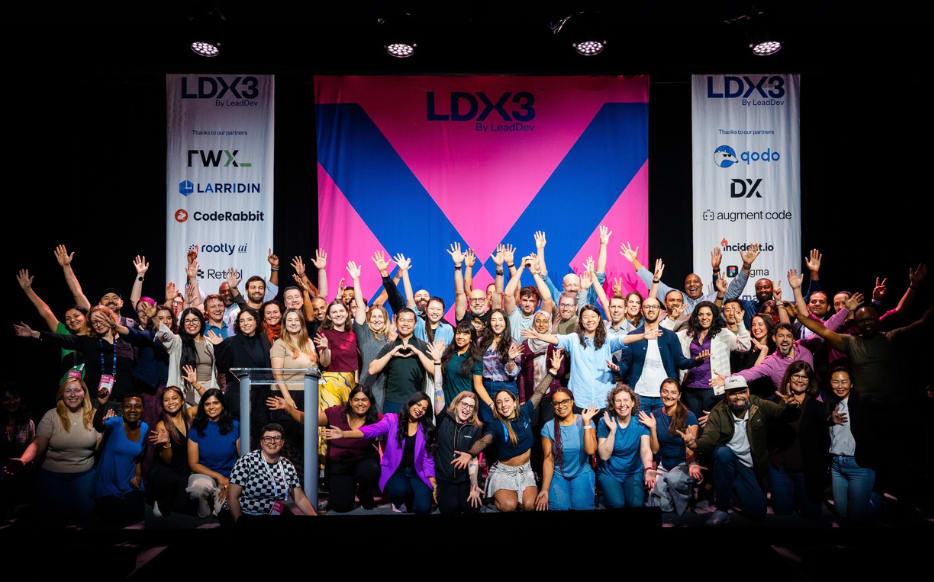
New York • September 8 & 9, 2027
Loved LDX3 New York? Pre-sale tickets for 2027 are now available.
What to do next
None of this calls for slowing down. It calls for being more deliberate.
- Say what success looks like. Name two or three business outcomes AI should move, such as faster time to customer value, fewer incidents, or lower cost per feature. Write them down and share them with the whole team, not just your peers.
- Pair every activity metric with an outcome. Keep tracking AI-assisted pull requests, but put them next to your change failure rate. Keep reporting time saved, but check whether lead time to customer value actually drops. Attribution will be imperfect, so look for a consistent direction across several measures.
- Treat workload as a success measure. Check in on load explicitly, and make deciding what not to build part of planning.
- Put a date on your experiments. Pick a point in 2027 to review what you’ve learned, adopt what worked, stop what didn’t, and share the results across teams.
Take this to your next team meeting
- Do we agree on what success with AI looks like? If not, why not?
- Would our current measures tell us if AI stopped helping?
- How has our workload changed, and is that sustainable?
Then ask your leadership the same questions and compare answers. The gap between the two sets of answers is where to start.
There are no perfect answers yet, and that’s okay. Try these questions with your team, and tell us what you find. Where did the time AI saved you actually go? We’d love to hear.
About the survey: 165 LeadDev Berlin attendees (November 9–10, 2026) took a voluntary, anonymous survey. Results describe this group, not the wider industry, and show association, not causation.
We asked how much each team relied on AI across the software development lifecycle. Heavy users answered “a lot” or “a great deal” (64%), moderate users “a moderate amount” (30%), and light users “a little” or “not at all” (7%). As the light group is small (11), comparisons are mainly heavy versus moderate.