You have 1 article left to read this month before you need to register a free LeadDev.com account.
Estimated reading time: 6 minutes
If you can’t distill a strategy down to a single statement, it’s likely not usable.
Most teams don’t struggle because a strategy is bad. They struggle because they can’t easily understand or use the strategy.
Abstract and sprawling strategy docs and decks mean teams never fully internalize what it means for them, and so they fail to apply it in their day-to-day decisions. Cue quickly eroding alignment and slowed-down teams.
What teams need instead is a concise, clear, and memorable vision that fills the gap between strategy and the daily work.
How vision supports strategy
I’ve found it useful to think of strategy as the input and execution as the output. Vision is what sits between them – the thing people actually interact with.
Company strategy is necessarily complex. It accounts for markets, competition, financial constraints, system constraints, and long-term bets. Teams, on the other hand, operate in the day-to-day: tickets, timelines, tradeoffs, and decisions.
Vision translates one into the other. A good vision allows people to answer, without hesitation:
- What matters most right now?
- What kinds of decisions are we empowered to make?
- How do we know if we’re making progress?
In software, a usable interface doesn’t expose all of its internal complexity. It breaks down a small number of clear affordances that help users take the right action. Vision works the same way.
Research published in Harvard Business Review found that people understand and internalize strategy most effectively when it can be expressed on a single slide, grouping the key direction into three or four core components and showing how they connect. Presentations that did this were far more likely to land and drive alignment than those relying on dense explanations or long lists of initiatives.
If your “vision” requires constant explanation or can’t be recalled with a few simple words, it isn’t usable yet.
Your inbox, upgraded.
Receive weekly engineering insights to level up your leadership approach.
Design a better vision interface
If vision is the interface between strategy and execution, then it’s worth being explicit about what makes that interface usable.
When translating a company strategy for your team, a vision must have three core tenets.
1. A good vision describes a clear, achievable future state
A strong vision works because it describes a future state clearly enough that people can orient themselves toward it. Not a task list or a set of initiatives, but a picture of what will be true when the work succeeds.
While at Etsy, I managed the team responsible for migrating our data warehouse from on-prem data centers to the cloud. This mattered for one specific reason: it was the last project standing between Etsy and shutting down its data centers entirely. The work itself wasn’t glamorous: migrating large sets of data warehouse artifacts, moving and verifying enormous volumes of data, and doing so reliably. It was an 18-month effort – long enough to become a motivation nightmare without care.
The underlying strategy was complex. But our vision was not. We worked toward one simple sentence: “Etsy is fully cloud-native by X date.”
That single sentence did a lot of work. It was time-bound, consequential, and easy to hold in your head. Everyone understood what “done” meant. It was ambitious but believable. And it narrowed focus: when teams faced multiple possible solutions, they could independently rule out options that would keep us in the data center or push us past the deadline. Decision-making didn’t require constant leadership input – the interface did the work.
And let’s not gloss over the fact that it’s quite exciting to be a part of the team helping the whole company become cloud native! The vision was inspiring; it made the project feel really important to be a part of. We were, of course, not the only team that completed migration work, but being the last team meant we got to unplug those final servers.
Many engineers later shared that it was the best project they’d ever worked on. Which is not what anyone predicts when you say “18-month data warehouse migration!” Our engagement survey scores were some of the highest in the company.
The work didn’t change. The vision changed the meaning of the work.
More like this
2. A vision must be believable to function as an interface
I’ve also seen the opposite: a vision that stopped working entirely because no one believed it could be done.
This was a many-year, large-scale technical effort with a vision to “deprecate the legacy system.” After more than five years of prior attempts to build a replacement with little visible progress, no one actually believed the future state described by the vision was achievable. The idea that we would fully replace the existing system had become abstract at best and laughable at worst.
As a result, the vision stopped guiding decisions. It didn’t help teams prioritize, make tradeoffs, or say no to work that didn’t move things forward. It didn’t unify people around a shared destination. Entire teams became disengaged, and not because they didn’t care, but because they couldn’t see a plausible path from the present to the promised future.
This is what happens when a vision fails its most basic requirement: believability.
Vision statements are meant to describe a future state that motivates and unifies people. But for a vision to function as an organizing tool, teams must be able to imagine that state as reachable. If the vision is perceived as unattainable, it stops shaping behavior and turns into empty rhetoric.
If you’re not sure the vision feels believable, ask people what makes it hard to believe. Their answers will tell you whether the problem is the vision itself or the conditions around it – and what needs to change to make the future state feel real.
3. A good vision constrains behavior as much as it inspires it
A good interface doesn’t just enable action, it constrains it. Vision works the same way.
A usable vision makes certain choices obviously right and others clearly out of bounds. It helps teams decide what not to do without escalating every tradeoff. That’s what constraint looks like in practice.
For example, compare these two visions:
- “Modernize our platform to support future growth.”
- “Become a fully cloud-native platform by the end of 2026.”
The first is inspirational, but it doesn’t constrain behavior. Almost any project can be justified in its name. The second rules out investments that deepen on-prem dependency. It favors solutions that move the deadline forward. Teams can independently say no to certain requests and possibilities, not because leadership told them to, but because the vision already did.
We can also see vagueness at play here. When teams can’t tell how their work contributes to a vision, they often respond by doing more. More projects. More meetings. More “yes.” The activity looks productive, but progress against the actual goal stalls because not enough is ruled out.
A good vision introduces just enough constraint to focus energy. It limits the space of acceptable decisions while still leaving teams room to think, adapt, and own the work.
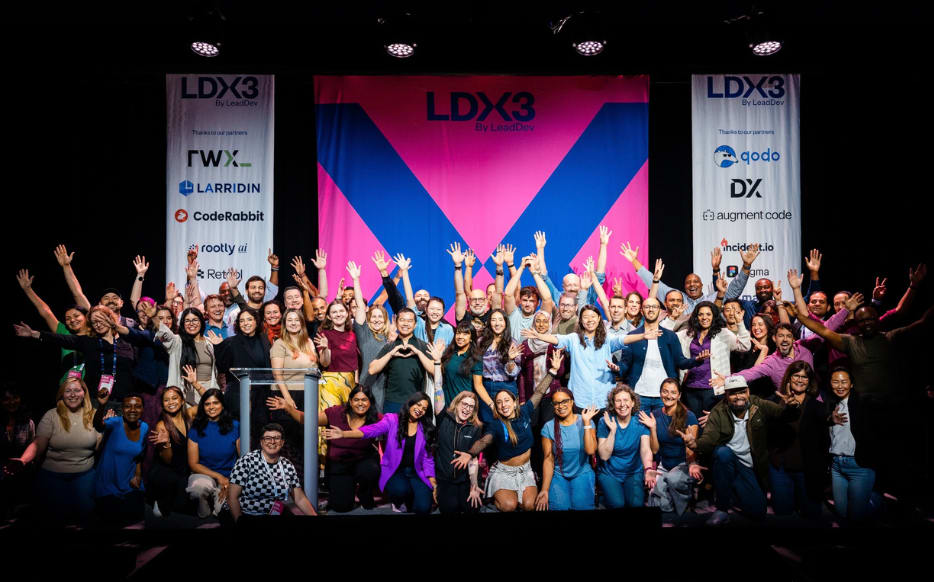
New York • September 8 & 9, 2027
Loved LDX3 New York? Pre-sale tickets for 2027 are now available.
Final thoughts
Just like the efficacy of a software interface, vision is best measured by how reliably users can complete core tasks correctly, efficiently, and without external help. Are teams able to use it to complete key tasks on their own? Does it speed up their ability to complete those tasks? Do teams feel confident they know what the “right thing” to do is? These are some of the signals that the interface is working.
And once the vision is clearly set, the work doesn’t stop. Our job as leaders becomes holding that vision.
We often assume that if a strategy or vision is important enough, people will naturally absorb it. But organizations are noisy, and without ongoing reinforcement, repeatedly making decisions aligned to the vision, even the clearest vision slowly degrades.
It takes more discipline than you might expect to keep gravity around a vision. But when you do, something powerful happens: teams stop waiting for direction, alignment becomes durable, and execution accelerates.
If your vision needs regular explanation, it’s not finished. And the real test isn’t whether people can repeat it back to you, it’s whether they are actually using it when under pressure and when the answer isn’t obvious.