You have 1 article left to read this month before you need to register a free LeadDev.com account.
Estimated reading time: 7 minutes
Key takeaways:
- The coordination layer is shrinking (and taking some managers with it). Org flattening and AI are compressing the work that defined many engineering manager roles.
- People management is necessary, but no longer sufficient.
- The floor is rising, are you rising with it? Those who don’t stay close to the code will be the most surprised when the role moves on without them.
Consider two engineering managers in the same organization. Imagine the founder asks why the payments service is slow under load.
One manager needs to set up a meeting with a senior engineer, wait for the answer, and relay it back. The other is close to the details. They can explain that the service was built for synchronous processing and hasn’t been rearchitected for the volume it’s now handling, and outline what the migration path looks like.
Both managers might be exceptional coaches and people leaders, but only one of them can operate at the speed the organization now demands.
Now, if you’re honest with yourself, you know which one you are. If you’re the first, it’s worth understanding why. Most people’s mental model of the engineering manager was forged in a specific era of cheap capital, rapid hiring, and deep management layers, where management in itself was the primary and sole focus of the role.
Your inbox, upgraded.
Receive weekly engineering insights to level up your leadership approach.
The evolving engineering manager role
If you look around in our industry now, you’ll see that that era is over. Your team already knows whether you’ve caught up with the change. I’ve seen this shift firsthand, and it’s made me rethink what I look for when hiring and developing engineering managers.
Two distinct forces are driving the shift. From above, organizations are flattening: middle managers made up 32% of layoffs in 2023, and the hiring pipeline for management roles has decreased 43% since 2022. From below, AI is automating the coordination work that defined many engineering manager roles: status updates, progress tracking, meeting summaries, and scheduling.
These are different phenomena with different causes, but they converge on the same outcome, compressing the coordination layer from both directions. If your value to the organization rests primarily on coordination, that value is shrinking.
People management is necessary, but no longer sufficient on its own. The floor is rising.
The coordination layer is compressing
So, what does this actually look like? It helps to separate the two forces, because they’re driven by different factors and move at different speeds.
The flattening is structural and economic. When capital was cheap and growth meant hiring, companies built deep org charts with layers of management to coordinate it all. When interest rates rose and the focus shifted to efficiency, those same layers became an obvious target: expensive, slow, and built for an era that was no longer being funded.
Amazon directed every senior team org to increase its individual contributor -to-manager ratio by at least 15%, a move that Morgan Stanley estimated could eliminate roughly 14,000 managerial positions. Google cut 10% of its management and VP roles in late 2024. Microsoft’s security division adopted what it calls the “builder ratio,” pushing towards a 10:1 engineer-to-PM ratio, up from 5.5:1.
However, this isn’t only a ‘big tech’ phenomenon. Bayer, the 160-year-old German pharmaceutical company, eliminated approximately 5,000 management positions and asked nearly 100,000 workers to self-organize under a programme called “Dynamic Shared Ownership.” A Korn Ferry survey of 15,000 professionals across 10 countries found that 41% said their companies had trimmed management layers in 2025. The trend is global, and it’s accelerating.
The AI pressure is different. It’s technological rather than structural, and more subtle in its effects. When an engineer can get an instant answer from an AI pair programmer instead of waiting for a colleague, or when an agent can scaffold an entire feature that would have previously required a design discussion, the need to coordinate between people drops. The coordination was never valuable in itself; it was a cost imposed by the limits of what one person could do alone. AI is removing that limit, and the data is starting to show it.
A Harvard Business School study tracking 187,000 developers on GitHub found that, after the introduction of Copilot, coding activity rose by 12% while project management activity fell by 25%, with a marked shift from collaborative work towards independent work. Engineers are coordinating less because the tools let them move faster alone.
Faros AI’s analysis of over 10,000 developers paints a similar picture: teams with high AI adoption merge 98% more pull requests (PRs), though PRs are 154% larger and bug rates rose 9%, a pattern they call the “AI productivity paradox.”
The trajectory is clear. Individual engineers are producing dramatically more output, and the emerging model looks less like companies running fleets of human teams and more like engineers orchestrating fleets of AI agents. What does that shift mean for you as a manager?
Well, for managers whose value rested primarily on being the connective tissue between people and teams, both of these forces point in the same uncomfortable direction: there is less to coordinate, and what remains demands technical judgment to do well.
More like this
The technical floor is rising
So, what does “technical” actually mean here? For a start, it means managers can code. AI tooling has made it genuinely feasible for a busy engineering manager to pick up tickets, prototype solutions, and stay close to the codebase in ways that would have been impractical three years ago. I know many engineering managers who are continually delegating tasks to AI in the background to make continual changes to their codebases.
More importantly, it means architectural literacy: understanding how your domain is built, how it performs, how it scales, and being able to explain the tradeoffs without calling someone else into the room.
I’ve written before about being in the details and the difference between being “in the code” and writing code, and that distinction still holds. However, the bar for what “in the code” requires is rising.
Leadership coach Lena Reinhard describes the rise of “super hybrid roles” that have always existed to a degree but are now becoming the norm rather than the exception. The role isn’t shrinking. It’s expanding to include genuine technical engagement alongside everything else.
Here’s the question: are you expanding with it?
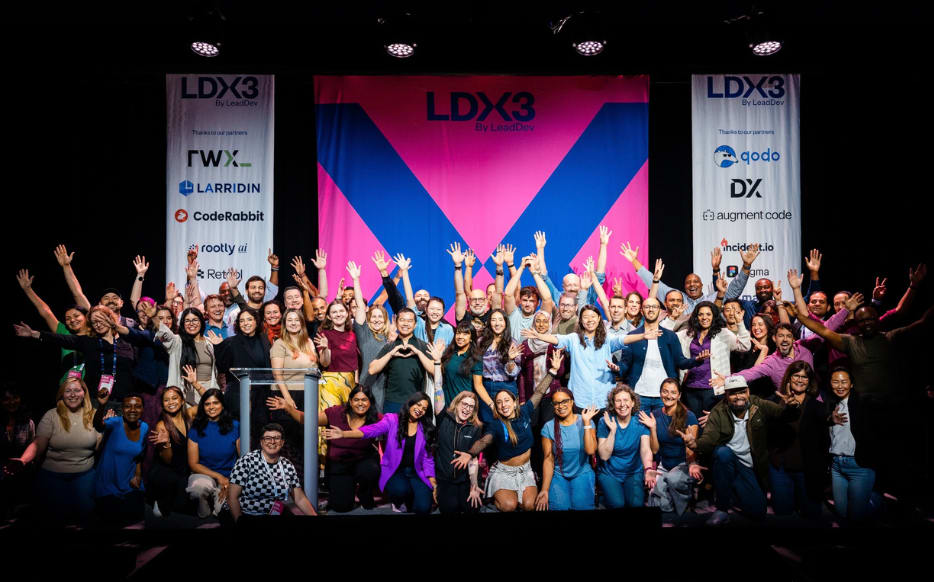
New York • September 8 & 9, 2027
Loved LDX3 New York? Pre-sale tickets for 2027 are now available.
Necessary but not sufficient
Before going further, it’s worth engaging seriously with the counter-argument, because it’s a strong one. There’s a meaningful difference between flattening and elimination.
When organizations have tried to remove the management function entirely, they’ve consistently found that the coaching, context-setting, and judgment that managers provided doesn’t just disappear. Someone still has to do it, and the cost of not doing it shows up in attrition, misalignment, and slower decision-making.
These arguments are right, and this article isn’t a case against people management. However, those skills alone no longer define the role.
The manager whose primary contribution was pushing information between layers, translating status updates upwards and context downwards, is the one most exposed by the forces described above. That version of the role is being automated and flattened away.
The version that’s growing in value is the manager who is an excellent leader, coach, and technical contributor. Someone who can develop their people, build a high-performing culture, and answer a probing question about how their system scales without deferring to someone else. I think of this as the compound skill, and it’s what makes the role irreplaceable.
Not everyone will make this transition, and that’s not a moral failing, but it is a career reality worth confronting honestly.
If you’re reading this and feeling a flicker of recognition, that’s the point. Many engineering managers have been meaning to get closer to the code for years and haven’t, not because they’re lazy or incapable, but because the old version of the role didn’t demand it and the calendar never had room.
The discomfort isn’t that this article is telling you something you don’t know. It’s that it’s telling you something you’ve been avoiding. I won’t pretend this is easy. More direct reports, wider scope, a rising technical bar, and the same number of hours in the day.
The managers who build the compound skill will find the role is getting more interesting, not smaller. The ones who read this, agree with it, and change nothing are the ones who’ll be most surprised when it moves on without them.