You have 1 article left to read this month before you need to register a free LeadDev.com account.
Estimated reading time: 9 minutes
Every engineer looking to progress in their career should consider putting together a group of diverse mentors.
Mentors are foundational in helping engineers through providing unbiased opinions on their work. Through recurring conversations around growth, team dynamics, product, and the business, engineers can collect feedback and help identify paths toward success.
A good rule of thumb for every software engineer is to have a mentor who is at least one or two steps ahead in the career ladder. In doing so, you guarantee that you can bring your issues to your mentors, who have almost certainly dealt with them before.
Considering all the wisdom gained in having one mentor, extending the network and creating a tribe of mentors can serve as a launchpad for career success.
What mentorship means at different engineering levels
For junior and mid-level engineers, the goal for mentorship is clear: technical excellence. You want to strengthen your engineering skills and build a solid technical foundation that lets you deliver projects with increasing complexity. Businesses rely on engineers who know their craft well and can produce high-quality results.
This is often translated into solution design, implementation, testing, and deployment. Mentees at this level generally focus on deepening their domain knowledge (like backend, database, frontend, etc.) and align their work with engineering best practices.
The other key area you’re looking to bolster is effective communication within the team. How do you communicate problems, ideas, and algorithms when collaborating with your team? Being able to share your thought process out loud makes you a solid team player, which is commonly one of the skills that interviewers evaluate for a software engineering position.
For senior and staff engineers, you’re looking to capitalize on impact and influence skills. Managing different stakeholders, delivering high-impact projects, and navigating inter-team relationships all depend on how you communicate as a technical leader. You want to be able to show that you’re good at producing high-quality results and that you can elevate your team and empower them to operate as high performers.
If you’re a senior leader already looking for guidance in the form of mentorship, you need to find a balance between both technical mastery and deep business understanding. What sets you apart is your ability to define technical direction, influence architectural decisions across teams, and maintain a strong engineering culture.
Whether you’re just starting out in your career or well settled in it, I’ve found that having mentors from three distinct categories is the best career resource you can invest in: a tribe of technical, product, and online mentors.
Your inbox, upgraded.
Receive weekly engineering insights to level up your leadership approach.
The three types of mentors
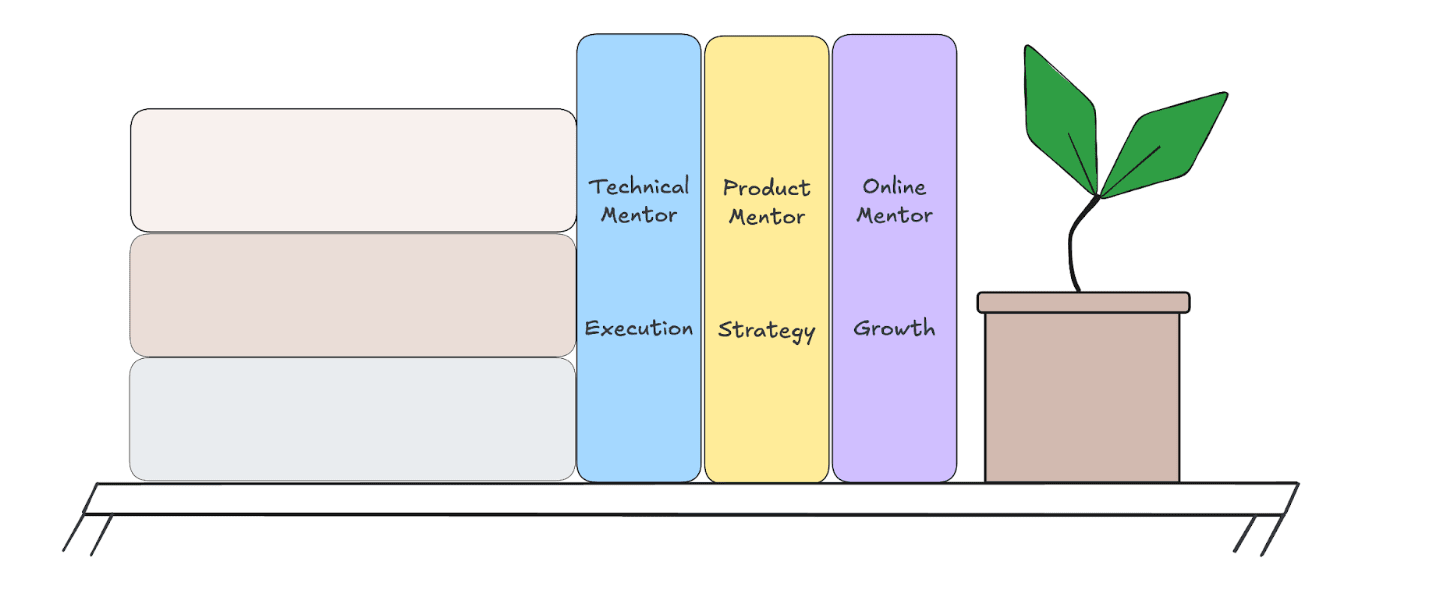
Technical mentor
A tribe of mentors starts with a technical one. This is an individual whom you both invest time and energy in working together to achieve your engineering goals. They ideally have full visibility into your work, strengths and weaknesses, and your interests as an engineer. They can help create a development plan to work towards a particular level. Examples of a good mentor in this category are; managers, lead engineers, staff engineers, or principal engineers. Having a technical mentor is not bound to a specific level, however, the value might be higher for early-career engineers than for those with 20+ years of experience.
How to find a technical mentor
This person should ideally be in your organization, where they can collect feedback on your performance from your peers and can suggest areas for improvement or new directions.
The key focus is execution. As a software engineer, you aspire to own larger projects with increasing scope and impact, and to be able to execute ideas with high-quality results that customers and stakeholders can see. For that, you’ll need a technical mentor who can help you uplevel your execution skills.
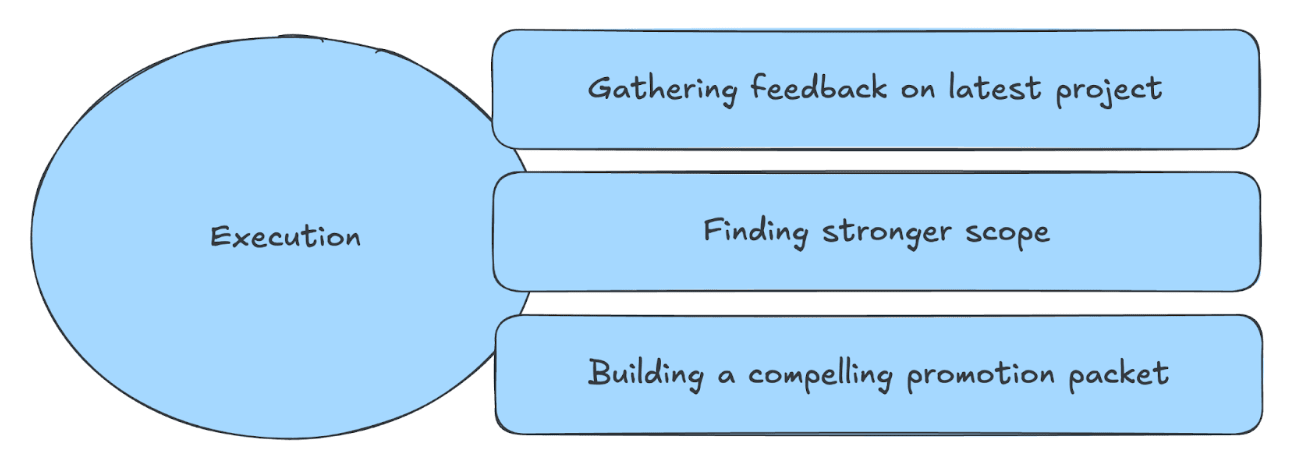
Technical mentors are usually your tech lead, staff engineer, or principal engineer in your organization. They might be assigned to you by default, or you’ll need to reach out and find one.
Finding a technical mentor requires you to show your willingness to learn through new initiatives you take or projects you proactively ask to be part of. If you don’t have a more senior person in your team, reach out to other individuals in different teams and build relationships. From there, you can find ways you can help them, possibly through some engineering initiatives, and they can support you back by offering mentorship.
More like this
Product mentor
A product mentor is someone who works in product management or design. These are individuals with a deep understanding of the customer pain points and are often the voice of the end user. They’re not necessarily technical, but rather someone who has either worked with you before, in the same industry, or collaborated with similar stakeholders. The goal behind product mentors is to develop product thinking and leadership skills. These traits are essential for product-minded engineers who want to lead high-impact projects, understand their customer base, and align with their company’s product roadmap.
How to find a product mentor
Having conversations with product people helps you understand the customer’s pain points, the solutions they’ve tried before, and what they’re looking for. This is the crux of product thinking.
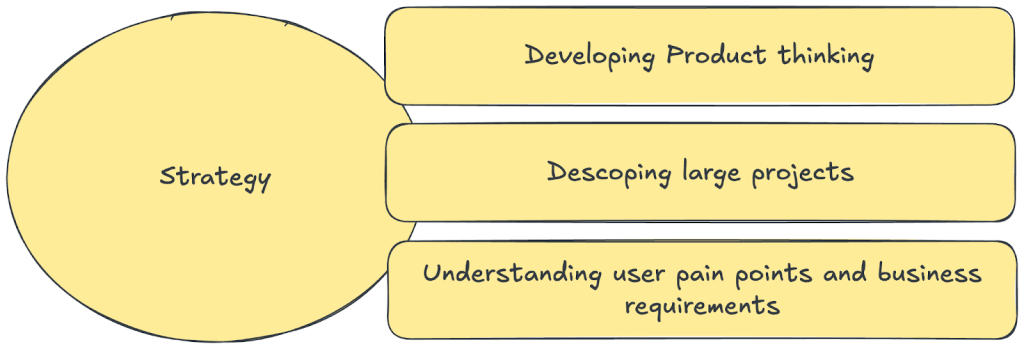
With their mentorship, the key focus here is strategy. Understanding the product vision, roadmap, and the business goals to achieve.
Finding product mentors starts within your team. Invest in having a relationship with your team’s product leader and see how you can make their work easier. It could be sharing engineering insights, discussing ideas, doing some project scoping, or providing technical opinions for future projects. All of which can improve engineering-product relationships.
If you don’t have a product manager in your team, look for one in adjacent teams or a high-level (e.g., product director). See how they work and what areas you can provide help for them as an engineer. You have the leverage with your technical expertise, while they have their product expertise. Finding ways you can help by sharing insights, taking initiatives, or managing projects, is a great starting point for asking for their mentorship.
Online mentor
An online mentor is someone outside your company who provides online mentorship sessions, or actively publishes content relevant to your domain. Whether that be leadership lessons, deep technical knowledge, or insights on overall product development. These are individuals who can not see your work on a day-to-day basis, but can provide mentorship from a different lens. Either they’ve worked in the industry for decades, or they have deep knowledge in systems you seek to acquire. An online mentor could be a distributed systems expert who teaches complex concepts on YouTube, a principal engineer who hosts leadership talks in their podcast, or a senior engineer writing about AI in their newsletter.
This type of mentorship requires minimal time commitment; it’s asynchronous knowledge sharing. You learn from their insights and apply them whenever applicable. While their advice won’t be tailored to your exact situation, you can adapt it to fit. Having access to different perspectives helps you understand how engineers operate outside your organization and how those one or two steps ahead perform at a higher level.
How to find an online mentor
Depending on your interests, these are people who publicly share knowledge and skills that can influence your professional growth. This could be around AI tools, leadership lessons, managing teams, leading projects, and more. You decide what knowledge you want to consume and leverage for your career development. I personally recommend keeping a small pool of people (~4-6) with focused areas and less noise. The key focus is growth, which could be a combination of product and engineering skills.

Use case: My tribe of mentors
Not too long ago, I was part of an infrastructure project that involved scaling our core database cluster for onboarding more customers to our platform. This was a critical project for my manager and skip-level so I had to make sure delivering it was a success. Thankfully, having my tribe of mentors helped me in different ways.
1. Technical mentor: Principal engineer
I reached out to a principal engineer outside my team, mainly because he has deep platform experience, which can help me with some technical directions. I proactively asked him for mentorship, especially for the next six months as I was taking on more leadership responsibilities, starting with this project.
One piece of advice I learned from him: do not mandate a solution you ideate yourself.
During that project, I presented two proposals we could follow to solve this scalability problem. My mentor reviewed the proposals and liked them, but he suggested I keep an open mind for other ideas from team members. Sure enough, I did get a third idea from another engineer, and I later pivoted my proposal to adopt a hybrid approach and built a stronger case with it. If I had been hyper-focused on my own proposals, I wouldn’t have considered other solutions that might have been better for the problem.
Product mentors: Two product managers
My company owned two product verticals, each with its own product managers. My team was one of the verticals with a product manager with whom I worked over the last year. We’d exchanged mentorship sessions – me being his engineering mentor and him my product mentor. The second product manager is someone I proactively reached out to learn more about the second product vertical that they owned. This was a new relationship I started to invest in because it allowed me to understand their product roadmap, and the impact of my cross-team project on them. For my tribe of mentors, I had built relationships with two product managers who were essentially my mentors from two different products. We’d have ad hoc or weekly catch-ups to discuss product improvements, customer requests, and engineering challenges.
Through their mentorship, I thought more like a product person, and have gotten better at presenting the right problem with the right solution at the right time.
New York • September 8 & 9, 2027
Loved LDX3 New York? Pre-sale tickets for 2027 are now available.
Online mentors
Some leaders that I look toward for guidance are Gergely Orosz, Author of the Pragmatic Engineer Newsletter, Steve Huynh, ex-Amazon Principal, and Evan King & Stefan Mai, founders of hellointerview.com
These industry thought leaders shaped how I take on new projects as an engineer. For instance, Gergely’s podcast episode with Sean Goedecke on shipping projects at big tech helped me think about stakeholder management and delivering projects differently. Steve shared Amazon’s Six-Pager memo that engineers followed when writing up detailed plans for leadership and executives in a concise manner. This influenced how I document my rollout plan and distribute new documents for my team. While these online mentors weren’t directly involved in my project, their frameworks and insights gave me mental models to apply.
Final thoughts
Career progression requires growth across multiple dimensions. Having one mentor is great for overall development, but sometimes not enough for a high-performing engineer. It first starts with building a strong technical foundation, then developing product thinking and leadership, and continuously investing in one’s knowledge and skills. Having this tribe of mentors in my experience is the best resource for your career.