You have 1 article left to read this month before you need to register a free LeadDev.com account.
Estimated reading time: 7 minutes
While leadership sets strategy and teams run experiments, staff+ engineers are uniquely positioned to translate ambition into scalable, sustainable outcomes.
Software development has undergone several major shifts in recent years: first with web applications, then cloud computing, DevOps, and mobile-first development. Each of these improvements changed how teams operate.
Most organizations are still in the early stages of AI adoption, often experimenting with projects. However, implementing a tool does not create transformational change.
History has seen this before. During the early adoption of electricity, factory leaders initially replaced steam engines with electric motors, expecting immediate productivity gains. They were disappointed. Output did not increase until engineers realized that electricity required a complete redesign of factory operations.
The current AI transformation resembles that period. Using models for test generation or ticket triage provides only limited benefits. Real breakthroughs come from redesigning workflows.
The role of staff+ in AI strategy development
AI doesn’t live in one team. It requires collaboration across product, data, security, and engineering. It requires cultural change, process optimization, and new technical infrastructure. As staff+ engineers, we’re able to maintain enough technical depth to execute tasks while also holding the influence needed to shape direction in this endeavor.
Our job is to connect messy reality to clear, shippable solutions. We mediate between different groups without formal authority, ask essential questions about whether a project is truly ready, and help develop an AI strategy while handling uncertainty and connecting teams. That connective work is the foundation; the question is how to turn it into day‑to‑day operating habits.
Your inbox, upgraded.
Receive weekly engineering insights to level up your leadership approach.
How to activate your impact
Based on my experience, staff+ engineers working on AI can drive meaningful adoption through three core operational methods.
1. Start small, learn fast
Staff+ engineers should launch small AI pilot projects that deliver high learning value. Teams can begin with small AI solutions, experiment with APIs, and test them in real‑world scenarios. This reveals where AI actually helps and where it introduces new complexity.
Through that exploration, ask:
- Are we chasing hype, or solving a real problem?
- What’s the minimal experiment we can run safely?
More importantly, build a repeatable framework. Others should be able to reuse your learnings – not just your code. In practice, that framework can be lightweight: a one‑pager that captures the problem statement, guardrails and risks, success metrics, and a rollout plan. If someone in another area can pick it up, plug in their own use case, and know how to run a safe experiment, you’ve done your job.
In practice, this can take on a few different shapes, but to illustrate, imagine a security‑critical environment. Security and fraud teams work at high speed, but AI evolves even faster. Automated fraud and prompt‑based attacks advance quicker than threat models and security policies.
Both security and engineering teams care about the same core outcomes – protecting users, reducing risk, and moving quickly – but they approach them differently. Engineering might want to launch an AI assistant for customer support agents as quickly as possible, while security is worried about prompt injection, data exfiltration, and unauthorized actions triggered by model output.
Part of the work a staff+ engineer can do to remove obstacles for both sides is to start with building context.
You can’t translate what you don’t understand yourself. Security translation requires a solid understanding of security, data, and models. You need to understand enough of both sides to speak credibly to each. Your research should go deep enough that you can confidently explain security issues, data management systems, and model behavior. Demonstrating expertise in these areas builds trust with stakeholders, which lets you propose a constrained pilot instead of an all‑or‑nothing launch.
If we take the example of engineering’s security solution of launching an AI assistant, that pilot might look like:
- Narrowing the first use case to a low‑risk workflow.
- Agreeing on strict input/output boundaries for the model.
- Capturing those decisions in your experiment template so future teams can reuse the pattern.
You’re not just running an experiment; you’re making it easier and safer for the next team to run theirs.
More like this
2. Build AI literacy across your org
Successful AI adoption depends on how well people understand the technology. Teams need your help to build AI literacy. This includes brief training sessions, open forums for questions, and simple AI systems that teams can test directly.
One of the most important lessons I’ve learned as a staff+ engineer is that technology only creates impact when people understand why and how to use it. You have to give people the language and context to engage critically with the technology. Every hour you spend improving organizational understanding multiplies the quality of decisions across dozens of teams.
One simple practice that’s worked well is a Slack channel where people share small wins and failures. This channel gives people a safe place to ask “naive” questions, surface real risks, and walk away with a shared language for talking about prompts, data, and failure modes.
In our security example, literacy is as much about framing the problem as it is about teaching the tools.
Picture a product team that just had their new AI feature blocked in an architecture review and comes back grumbling that “security said no.” As the staff+ engineer partnering with both groups, you can reframe the conversation in a joint working session: instead of “security says no,” say, “Here’s the security team’s goal. Let’s explore how we can meet it without blocking progress.”
By getting everyone to agree on the problem statement, you can align disconnected stakeholders and ensure the team is working towards a common goal. That’s AI literacy too: helping people see risk, constraints, and opportunity with the same mental model, instead of talking past each other.
When people build that literacy, they start asking sharper questions and making better calls. Over time, the technology will change, the tools will age – but the clarity you spark in others endures beyond the tech, and that will have a long‑lasting impact in your organization.
3. Decide what to maintain and what to transform
AI exposes system weaknesses: poor data hygiene, slow feedback loops, brittle APIs. Staff+ engineers are in the best position to decide what to maintain, when to update, and when to rebuild systems.
The main goal of AI implementation should be dependable systems, not just clever demos. As a staff+ engineer, that means making judgment calls about where AI should or shouldn’t make decisions, where humans must stay in the loop, and which workflows are safe for aggressive automation. Instead of sprinkling models everywhere, you’re choosing the few places where better predictions or faster decisions materially improve reliability or customer outcomes – and intentionally leaving some parts of the system boring and deterministic.
This is also where matching patterns becomes essential.
Even though all of these AI protocols and integrations are new, you can draw from your past experience, past incidents, postmortems, and system designs. New tools do not change the underlying failure patterns in systems. Organizations still face familiar issues, such as system failures, bad data quality, and architectural breakdowns. These past failures can guide the design of solutions that protect users and remain effective.
In practice, that turns into clear design approaches:
- Standard patterns for when models can call internal services.
- How model outputs are logged and reviewed.
- When a human must approve high‑risk actions.
- Where you rely on deterministic checks instead of model judgment.
Your main responsibility is to create conditions where good solutions can emerge. That means insisting on good observability and feedback loops, carving out safe sandboxes for teams to experiment, and baking in mechanisms like red‑team exercises and post‑incident reviews for AI systems. You’re not the only person with good ideas – you’re the one making sure the system and the culture are set up so those ideas can surface and be tested safely.
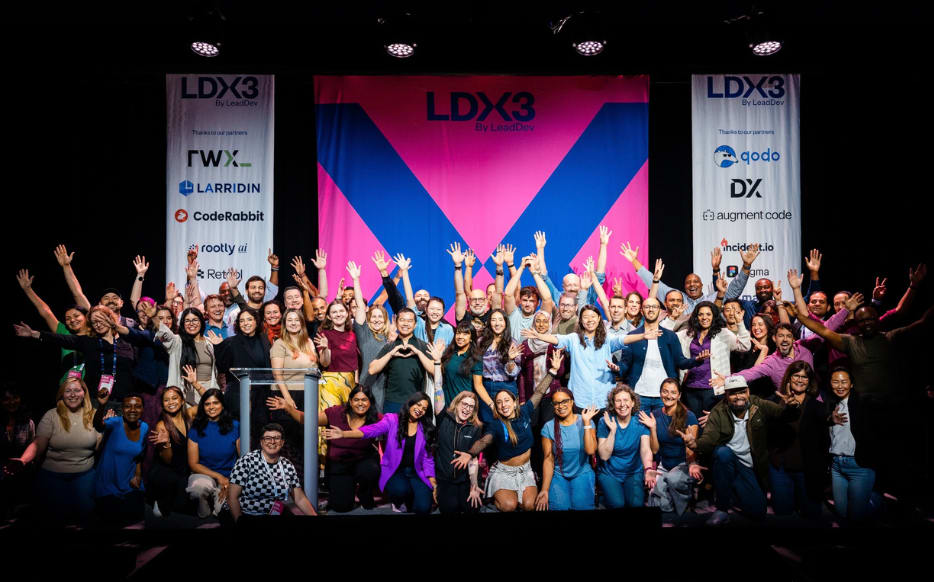
New York • September 8 & 9, 2027
Loved LDX3 New York? Pre-sale tickets for 2027 are now available.
Closing thoughts
Organizations that treat AI merely as a tool will end up with expensive toys. Organizations that treat AI as an impetus for operational redesign will build the future. The difference between the two is often the presence of a staff+ engineer in the room.
Whether you’re in a staff+ role today or moving toward one, you’re not on the sidelines of this transformation. You are one of the people who will determine whether your organization moves from AI experiments to AI impact. The real question isn’t, “Will I be involved in my company’s AI strategy?” It’s, “Am I going to be one of the people who designs the operating model that makes this actually work?”
So start there and help your organization unlock the real value of AI – not by adding tools, but by changing how work gets done.