You have 1 article left to read this month before you need to register a free LeadDev.com account.
Estimated reading time: 9 minutes
Key takeaways:
- The industry has lost its independent benchmark. Google has stopped running the annual DORA survey.
- AI makes measurement more urgent as leaders struggle to prove ROI.
- You can run DORA yourself! The questions are free on dora.dev.
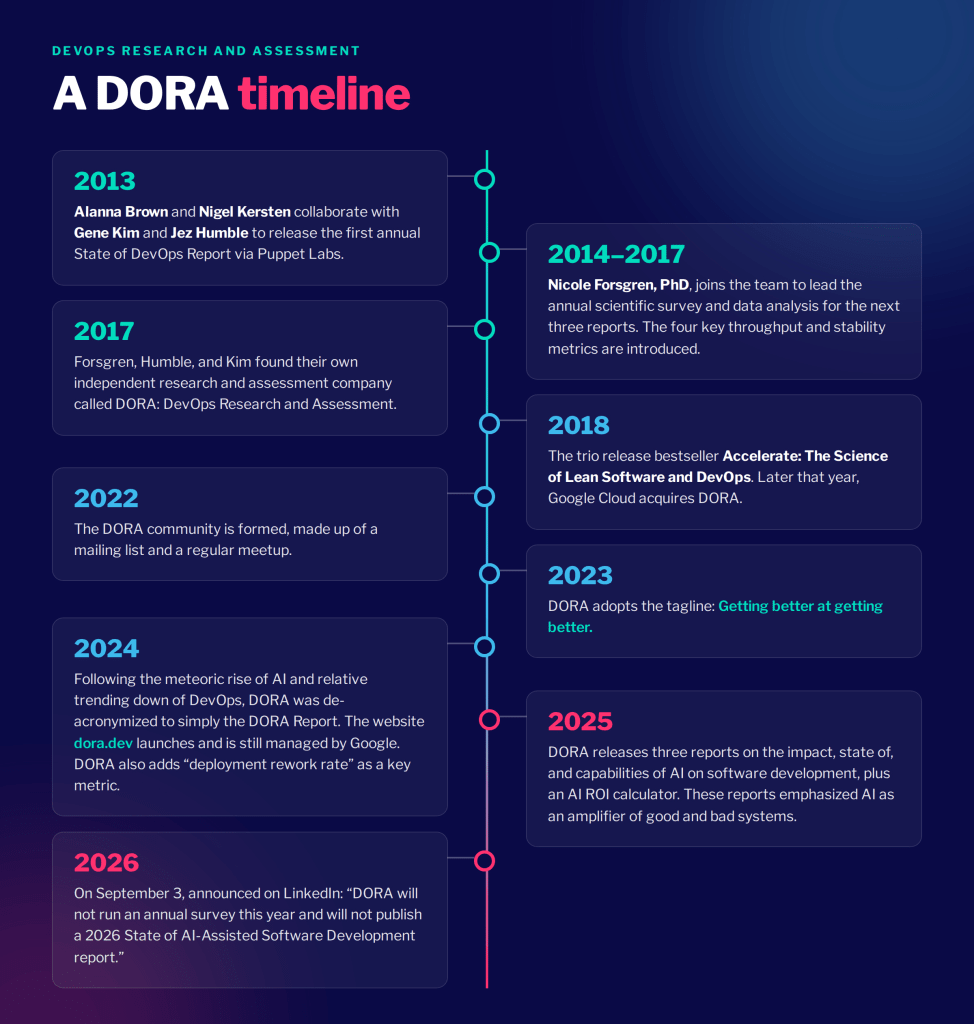
If the 12th annual DORA report was going to be published, it would’ve been out by now. However, the DORA team, housed within Google Cloud, announced in September that it wasn’t going to run the survey behind this well-respected benchmark of software performance.
As Lauren Peate, CEO of Multitudes, puts it, for more than a decade, the DORA team’s research had engineering leadership focus on the biggest question: how do software engineering activities link to customer value? In the age of AI, this question is more crucial than ever.
“DORA took us out of the world of measuring lines of code, and also showed that we can link engineering work to customer outcomes.” DORA was so valuable because of its independence as a developer productivity framework that is not owned by a developer productivity vendor, Peate says.
“DORA was started by fully independent academics and, at least pre-Gemini, Google’s only vested interest was that they wanted us to buy their cloud software – but they didn’t care what the metrics were or what platform you used to measure them.”
DORA’s research was perhaps one-of-a-kind because it gave a global, anonymous view without ever zeroing in on any specific technology or industry. While its four key metrics are quantitative, so much of it was a qualitative look at not just technology but people and processes too.
It feels like the end of an era. So what does this mean for engineering leadership entering 2027?
Your inbox, upgraded.
Receive weekly engineering insights to level up your leadership approach.
What happened to DORA?
We don’t know Google’s reasoning for ceasing to run the annual DORA survey. However, following the objectively mid results that came out of the 2025 DORA research into the ROI of AI assisted software development, it didn’t come as a shock to everyone.
“I think Google is a big enough firm that something like DORA could hide until it said something that people didn’t like,” Sam Newman, a technologist and author of Building Microservices and Building Resilient Distributed Systems, tells LeadDev.
“I’m not surprised about it though, because the challenges that it highlighted around our use of AI-driven software delivery don’t actually help Google’s products,” he continues. “There’s concerns around increased failure rates, for example, and fairly modest improvements don’t look great when you’re a company that’s gone from being cash flow positive to cash flow negative on the basis of building out massive amounts of infrastructure for AI.”
One thing we know for sure is that DORA wasn’t waning in popularity.
“I would say that the 2025 report was our most successful report that we’ve had to date,” Nathen Harvey, who until recently was the DORA lead, tells LeadDev.
“As DORA came out with the State of AI-Assisted Software Development, we saw tremendous uptick both in interest as measured by the number of downloads and independent news entities that were covering. We got a lot more press coverage and analyst coverage in 2025 than we had in previous years, on the order of 5x the number of press coverage.”
While DORA won’t run its annual survey this year, it will continue in some way. Its LinkedIn post from September alludes to more qualitative and observational research. The announcement reads: “exploring how these types of efforts will help us respond more quickly to changes in the landscape and bring forward the next chapter of DORA.”
LeadDev reached out to Google, and a spokesperson responded. “We recognize the importance of the research that DORA has provided to the developer community, and we are currently exploring how we can best support the future needs of developers with meaningful insights.”
What’s next for DORA?
This kind of rigorous, transparent, industry-wide research must continue. That’s because, despite the billions invested into AI, few best practices have emerged for how to measure and drive continuous improvement with AI-assisted development across teams and organizations.
This is especially true in light of what AI researcher Annie Vella dubs the productivity-experience paradox. While productivity continues to go up, in the age of AI, the developer experience has begun to drop.
Atlassian’s State of Teams 2026 report states that 89% of executives believe AI has increased the speed of work, but only 6% can connect that speed to organization-wide return on investment (ROI). Teams, or at least individuals, are moving faster but not necessarily in the right direction.
Perhaps the DORA survey, only running once a year, couldn’t keep up with AI’s rate of change. While the questions still remain relevant, it often trailed market trends, giving its results a shelf life. Also, by its nature of being anonymous, it wouldn’t allow for longitudinal studies, although some organizations likely have been running those privately.
Across the last 14 years, there has always been a lot more research than just DORA and that will also continue, including from software engineering intelligence vendors that instrument the lifecycle, Harvey says.
“There’s a lot of telemetry data that DORA has never had access to. Vendors – I think of Jellyfish, Multitudes, Opsera, and Harness – all have deep, rich insights into what’s actually happening through telemetry.”
Harvey thinks a mix of qualitative surveys and this telemetry is the best way to gain insights into what’s happening.
More like this
Impact of the DORA survey no longer running
There’s no doubt that the people who care about developer experience care that DORA is now MIA.
“DORA was living research – it evolved with the times,” Peate says. “The end of Google’s funding means it’s not getting the support to keep evolving. As it was updated each year, it had an ongoing influence on how our industry approaches these metrics. I and many others had October set aside to read the latest results.”
The huge loss is that we no longer have a funded research team evolving the metrics alongside the changes in how we work, Peate adds. “This is especially significant with the massive evolution we’re all facing with AI.”
Steve Fenton, director of developer relations at Octopus Deploy, who attended the very first DORA community discussion back in October 2022 and almost every one since, expresses grief.
“We’ve always had amazing research efforts around software delivery but what DORA achieved was exceptional. They finally managed to elevate the findings out of the development teams and into the hands of leaders,” Fenton says. “DORA has done more to bring awareness of healthy metrics, technical practices, and cultural capabilities to those in the exec offices than any prior effort.”
Kevin Storer, now principal engineer at Storer Enterprise Strategy, was a senior researcher at Google and the qualitative research lead at DORA from August 2023 through December 2025.
“It was the privilege of my career to be able to work on that team and to see how the rigorous, transparent, nuanced research that we were able to provide impacted the daily practices of DevOps and software development and organizational policy for people worldwide,” Storer says. “The impact of DORA is immeasurable, and that impact doesn’t cease just because the survey is no longer being fielded.”
Who can take the mantle?
There’s no doubt that DORA inspired a lot of organizations to measure the software development lifecycle, including companies that wanted to monetize that challenging endeavor.
“It’s a shame that valuable piece of ongoing research, with a history and a methodology that is fairly transparent, is going to go,” Newman says. “The challenge we’ve got is that a lot of the reports that come out are often coming from organizations which are looking for a certain set of results to justify their own existence.”
A logical replacement would be an independent analyst firm to run the survey, but they would likely paywall the results as their research often becomes pay to play. Google’s biggest hurdle to DORA’s wealth of research was a business email, publishing all its research for free.
New York • September 8 & 9, 2027
Loved LDX3 New York? Pre-sale tickets for 2027 are now available.
Products that survey and measure developer experience, including DX, LinearB, Quotient, Larridin, and Swarmia, will continue to measure DORA metrics among others. It’s just that organizations that invest in tooling to measure developer experience tend to have more positive results than the industry as a whole, so any reports out of these companies, while welcome, cannot offer as accurate a benchmark.
Of course, nothing is stopping engineering organizations from running their own surveys. DORA is licensed under Creative Commons and Apache, so you can still fork any of it to run your own survey.
“The intent of publishing the survey questions each year, which we’ve done for a number of years on dora.dev, has always been to enable teams to go and replicate the research,” Harvey says. “When DORA goes out and researches the world, that doesn’t necessarily apply to your context. So you always have to take the findings from DORA and contextualize them for your team and your organization. By publishing things like the survey questions, we enable you to do that contextualization a lot faster.”
Run an internal survey, he recommends. It doesn’t have to be all 150ish questions, but instead pick the ones that are important to your business. Get your baseline numbers, plan an experiment, make a change or intervention, and then measure that change.
“Companies that do measure developer experience and their performance with rigor and discipline tend to have better outcomes, because they know what’s happening and they can detect things early,” Laura Tacho, senior principal technologist at Amazon Web Services (AWS), tells LeadDev. “Developer experience is more important now than ever. Even when agents are doing most of the coding, the tenets of developer experience are still so important,” whether you are reducing it for human or agentic developers.
“DORA has shown that our industry has a need for transparent research to monitor changes across the evergreen topics of maintainability, quality, developer experience, developer satisfaction, and team performance,” Tacho says. “There’s also a need for more timely deep dives into the problems that are coming up as things are moving so fast.”
This week, Harvey joins Tacho’s team at AWS, where the pair will lead builder research with these goals.
“I’m excited to work with Nathen on building a research group that respects what came before and also meets the new needs of developers and leaders trying to navigate these big AI shifts,” says Tacho.
“There has always been a lot more to DORA than just a few software delivery performance metrics,” says Harvey. “There’s always been this much deeper research into the capabilities and conditions that drive that software delivery performance. It’s not just research. There are hundreds, maybe thousands, of organizations that have built organizational transformations on top of insights that they’ve learned from DORA.”
For now, the best way to support the continued, collective conversation around helping tech teams get better at getting better is by joining the DORA community for semi-regular lean coffee style, off-the-record discussions.
While we don’t know what questions would’ve been included if the DORA survey was run this year, we can be confident that it would’ve explored the impact of agentic AI on modern organizations. In a follow-up article, we’ll dive into the questions you could be asking.