
You have 1 article left to read this month before you need to register a free LeadDev.com account.
Estimated reading time: 6 minutes
Key takeaways:
- Mid-level engineers are subsidizing everyone else’s AI productivity – and burning out for it.
- The warning signs are there if you look closely: the invisible validator problem is probably already in motion.
- The fix is making oversight explicit. The engineers burning out today were meant to become your senior leaders tomorrow.
In today’s software world, AI-coding assistants have created a crisis nobody is talking about. Juniors are shipping faster than ever. Seniors are architecting with less effort. But what about your mid-level engineers?
They are quietly drowning, spending most of their time catching AI mistakes that never show up on any dashboard. No credit. No recognition. Just burnout.
I call this the “invisible validator” problem. Drawing from building AI platforms serving over 100 million users at enterprise scale, this article explores how your best engineers are subsidizing everyone else’s productivity… and what to do before they leave!
Your inbox, upgraded.
Receive weekly engineering insights to level up your leadership approach.
The exit conversations I wasn’t prepared for
Last quarter, the numbers looked great. We were shipping 40% faster. Code reviews that used to take days were done in hours. Leadership loved it. We were the team everyone pointed to as proof that AI adoption was working.
Then three of my best mid-level engineers quit. All within six to eight weeks of each other.
I sat in all of those exit conversations thinking I’d hear something different each time, such as a better job offer, a life change, or something I could file away as circumstance. However, all three said a version of the same thing. One of them put it plainly:
“I cannot handle this pressure of making things right without any credit for it.”
That statement stopped me and made me think very deeply.
While the rest of us were celebrating velocity, they were quietly absorbing work that never made it onto a sprint board. Fixing AI mistakes. Adding the context models missed. Making sure generated code would actually hold up in a regulated production environment. None of it showed up in metrics, performance reviews, or promotion conversations.
We had figured out how to move faster, but someone was paying the price. It was exactly the people we could least afford to lose.
This is not unique to my team. A survey by GitLab found that while the vast majority of developers reported that AI tools improved productivity, a significant portion flagged concerns about code quality and the review burden that came with it. The speed gains were real. So was the hidden cost.
Why this burden lands on mid-level engineers
As we all know by now, AI tools genuinely help. Junior engineers feel productive from day one. Senior engineers go from whiteboard sketch to working prototype before lunch. Yet, somebody still has to catch the security gaps, compliance risks, and architectural conflicts buried in years of tribal knowledge.
That somebody is almost always your mid-level engineers. They are experienced enough to spot what is wrong, but not senior enough to push the work elsewhere. So they absorb it quietly, and the output they actually get credit for shrinks.
On my team, one L5 engineer spent the better part of three days stopping an AI-generated authentication flow that would have created audit log gaps in a regulated system. She caught a compliance risk that could have triggered a formal review process. When I looked back at her sprint that week, she had zero points to show for it.
The problem is structural, not personal. AI tools are optimized to produce output. They are not optimized to account for your compliance posture, your aging service mesh, or the undocumented agreement your team made with a downstream dependency a few years ago. Mid-level engineers hold that context.
When AI generates code at speed, someone has to bridge the gap between what the model produced and what your actual system needs. Right now, that work is invisible and it keeps falling on the people least positioned to say no.
More like this
The warning signs hiding in plain sight
The signals are there if you look for them. Mid-level engineers go quiet in meetings. Not disengaged, just exhausted. Architectural discussions start going binary: juniors ask questions, seniors make calls, and the people in between stop contributing. That silence is worth paying attention to.
Code review queues move faster, but production incidents start creeping up a few weeks later. This is the lag effect. Validation work that used to be explicit, a slow review, a real back-and-forth that becomes invisible. The queue looks healthy. The defect rate tells a different story.
You start losing L4s and L5s while juniors and seniors stay. This attrition pattern is the most telling. Junior engineers are gaining leverage from AI tools. Senior engineers are unblocked by them. Mid-level engineers are absorbing the overhead of both, without the recognition, and without the seniority to offload any of it.
If you are seeing any combination of these on your team, the invisible validator problem is likely already in motion.
4 changes that make the invisible work visible
The fix is not to slow down AI adoption. It is to stop pretending oversight happens for free.
1. Build AI validation into sprint capacity, explicitly
We created a dedicated AI Quality Gate role each sprint, a named responsibility, tracked like any other. Not a side task. Not assumed, but well planned. That one change shifted how the team talked about the work. When validation has a slot in the sprint, it has value.
2. Measure what engineers prevent, not just what they ship
Velocity metrics count output. They do not count the production incident that did not happen, or the three days an engineer spent making sure an AI-generated service would not silently corrupt data downstream. Adding “defect prevention rate” as a tracked metric and tagging AI-generated code in your repositories gives you a clearer picture of where review effort concentrates.
3. Restructure code review as knowledge transfer
When an engineer silently approves AI-generated code, the reasoning disappears. We started asking for brief written rationale on AI-assisted approvals but not for formal documentation, just a sentence or two on what was checked and why it passed. Over time, this distributes context across the team instead of concentrating it in the same two people.
4. Rotate validation work deliberately
If the same engineers are always the ones catching AI errors, that is a load distribution problem, not a talent one. Rotating the Quality Gate role makes the work visible to senior engineers and leadership, preventing the quiet accumulation that burned out my team.
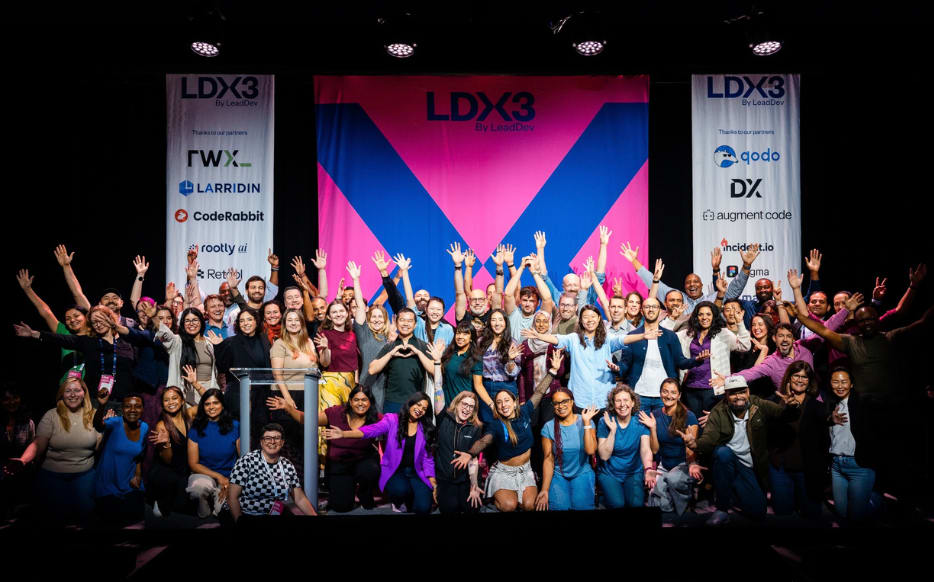
New York • September 8 & 9, 2027
Loved LDX3 New York? Pre-sale tickets for 2027 are now available.
AI productivity and engineer burnout
The engineer who told me she could not handle the pressure of making things right without credit for it was not being dramatic. She was being precise. She had diagnosed something real, and she was telling me directly. I just did not have the framework to hear it yet.
AI did not eliminate human judgment but it shifted the burden. Most of that weight landed on mid-level engineers who rarely get credit for carrying it.
Speed is not the same as sustainability. Mid-level engineers bridge design and execution. Lose them, and you lose institutional judgment no model has learned and no prompt can replicate. The engineers quietly burning out today were meant to become your senior leaders tomorrow.
Sustainable AI productivity does not happen by accident. You have to plan for human oversight explicitly, fairly, and with the same rigor you apply to velocity targets. Start by asking your mid-level engineers what their week actually looks like.
You might be surprised by what you have not been measuring.


