You have 1 article left to read this month before you need to register a free LeadDev.com account.
Estimated reading time: 5 minutes
Flatter organizations create proximity to leadership, and that can be effectively leveraged.
One of the biggest cultural shifts we’ve had to deal with as managers in the last few years is the flattening of organizations. With fewer layers in the hierarchy, feedback travels faster between those doing the work and more senior decision-makers who can amplify it.
The managers who thrive in this environment are the ones who show what they’re building, keep a tight pulse on outcomes, and use the newfound proximity to leadership to elevate their team’s work.
Let the work speak for itself
When economic times were better, and headcount was not under such scrutiny, managers could take a more hands-off approach to leadership, spending their time on coaching, communication, translation up the org chart, contextualization, and improving the culture within their team. This time of less scrutiny fundamentally meant that if your manager didn’t always know what you were doing, it was fine. There was a default trust that you were applying yourself in the best possible way, with your team’s output as the sole proof.
Today’s flatter organizations operate on a new yardstick. Two years ago, a manager who spent their week unblocking a contentious cross-team dependency, coaching a struggling engineer, and refining the team’s roadmap for next quarter would have been seen as doing excellent work. Today, the same manager might be asked: “but what did you actually ship?”
If you were asked what you shipped this week, would you have an answer? If you can’t, it’s worth thinking about how you can make some tweaks to the way you work to ensure you can confidently answer this question. With end-of-year performance reviews coming, it’s not too late to lean into the tools and practices that make that possible.
Your inbox, upgraded.
Receive weekly engineering insights to level up your leadership approach.
A use case: How Nvidia’s flat org unlocks leverage
Nvidia offers a powerful example of what these tools can look like in practice. Every employee is encouraged to send a “Top 5 Things” (T5T) email that highlights their most important outcomes, no matter their level. Nvidia founder Jensen Huang reads more than 100 of these messages every day. The intent isn’t surveillance – it’s direct access.
Because these emails flow straight from the edge of the organization to the CEO, Nvidia surfaced inflection points like the rise of modern machine learning years before competitors. Engineers’ work is visible to the top of the company, so they feel ownership over strategy, not distance from it. Decisions move faster because leaders aren’t waiting for rolled-up reports; they are hearing directly from the people closest to the details.
To help amplify your impact in tech’s new flattened landscape, you can borrow Nvidia’s principles: make it easy for people to broadcast real progress, and make sure senior leaders are encouraged to read and respond.
A lightweight framework that echoes Nvidia’s T5T practice looks like this:
- Assign an accountable engineer to every project so ownership is clear.
- Ask each owner to share a short weekly update that states the outcomes achieved since the previous check-in, highlights upcoming bets, and calls out any help needed.
- Deliver those updates in the open – an email list, an internal post, or a short Loom demo – so product, design, and executives can see the work directly.
The benefits run both ways. Your engineers get recognition and feedback from leaders they might rarely meet. Senior leadership gets an accurate pulse without layers of translation, and you get to steer the narrative by tying every update back to the metrics and customer signals that matter.
The openness this encourages shows confidence, builds trust, and helps everyone make faster, better-informed decisions.
More like this
Stay technically credible through strategic IC work
Flatter organizations reward managers who can operate as both coaches and builders. That doesn’t mean doing two jobs at 100%; it means intentionally reserving a meaningful slice of time for strategic individual contribution that unblocks your team and keeps you close to the work. When there are fewer layers between you and the CEO, your work is evaluated more directly, and “I coached my team” is harder to justify than “I built this.”
How you use that time is up to you, but here are some approaches that maximize impact without doubling your workload:
- Pair program on pivotal features using Tuple or VS Code Live Share, and lean on Claude Code or Codex to explore alternative implementations while you narrate trade-offs and model the quality bar you expect.
- Use AI tooling along with MCP-enabled issue trackers like Linear to prototype solutions in the background, fix nagging bugs, or generate scaffolding that accelerates the team.
- Sweep the backlog for high-impact papercuts by creating tooling to cluster related issues, have AI draft remediation plans, and then ship the fixes yourself so the team sees you creating momentum, not just requesting it.
- Build or automate the internal tooling that removes friction, creating an agent to generate dashboards, incident timelines, or compliance guardrails you can hand off to the team.
- Pipe customer and support signals straight into the team by scripting summaries from Zendesk, Gong, or Salesforce with agents so everyone can react faster to information at the periphery of the company.
- Co-create early technical spikes with product and design by pairing in FigJam or Notion while an MCP coding agent scaffolds the experiment, and narrate what “good” looks like as you guide the AI’s iterations.
This sort of contribution keeps you technically credible, demonstrates the standards you want to see, and creates visible outcomes that leadership can rally behind. It also earns your engineers’ trust – they see you investing in the same outcomes they care about.
New York • September 8 & 9, 2027
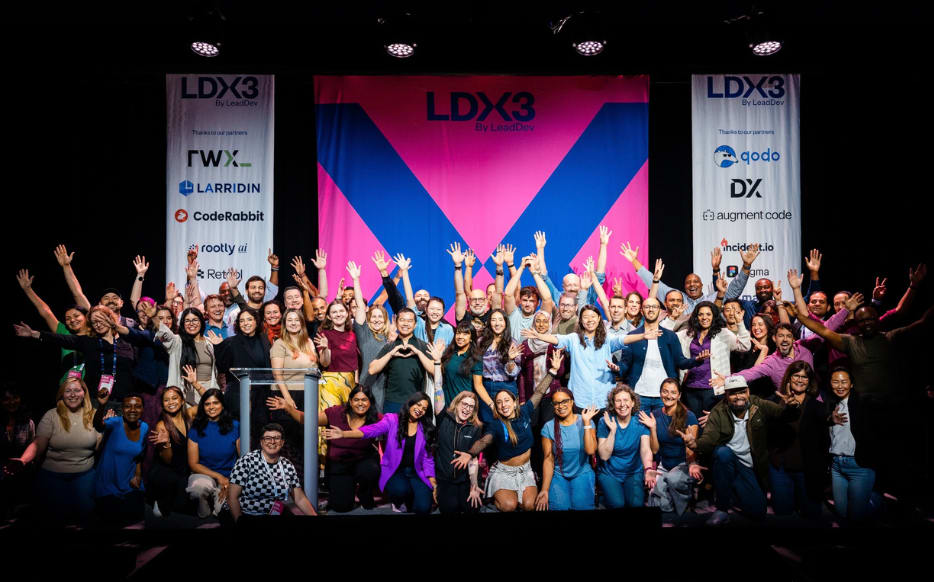
Loved LDX3 New York? Pre-sale tickets for 2027 are now available.
From scrutiny to spotlight
Flatter organizations aren’t something to survive – they’re a spotlight waiting to be used. When you stay close to the work, create space for strategic hands-on contribution, and broadcast meaningful progress, you give your team direct access to the people who can champion them.
This week, pick one project and pilot the T5T-style update rhythm: name the accountable engineer, share the outcomes openly, and ask leadership for a response. You’ll feel the loop tighten almost immediately. Keep iterating on that cadence, and the increased visibility stops feeling like scrutiny and starts feeling like momentum.