
You have 1 article left to read this month before you need to register a free LeadDev.com account.
Estimated reading time: 5 minutes
Key takeaways:
- The “AI is killing jobs” narrative isn’t supported by data. Nearly half of companies report AI-driven job creation.
- AI is redistributing talent, not eliminating it: same headcount, different role mix. New roles are emerging faster than old ones disappear.
- The leverage has shifted. AI raises the bar for entry-level work and increases demand for high-level judgment.
AI has become a scapegoat for mass layoffs, but reports and software leaders tell a broader story of role reorientation.
There’s no denying that AI-driven layoffs seem everywhere. Nearly every day brings another high-profile reduction, including recent cuts at Oracle, Amazon, Meta, Block, and Atlassian.
Yet, this steady stream of high-profile AI layoffs might be distorting the economic reasons behind these decisions and overshadowing what is occurring within software engineering at large.
“The actual AI-driven shifts are quieter and don’t make headlines: same headcount, completely different role mix, dramatically faster cycle times,” Michael Bevilacqua, VP of AI product management at Adeptia, a data automation platform, tells LeadDev.
Contrary to mainstream coverage, nearly half of companies are reporting AI-driven job creation, compared to 18% that report AI-related layoffs, according to Reveal IT’s 2026 survey of 250 CIOs, CTOs, VPs, and IT managers and directors.
“The ‘AI is killing developer jobs’ narrative is a lot more nuanced than current headlines suggest,” Zach Lloyd, CEO and founder of Warp, makers of an agentic IDE, tells LeadDev. “Instead of AI replacing engineers full stop, it’s changing what engineers actually do day to day.”
Your inbox, upgraded.
Receive weekly engineering insights to level up your leadership approach.
AI layoffs don’t reflect the broader trend
David George, general partner at investment firm Andreessen Horowitz, says “the AI apocalypse is a complete fantasy,” citing the fact that software engineering job postings have been climbing since early 2025.
“I see the AI layoff headlines as noise, not the center of the trend,” adds Tom Howlett, director of AI engineering engagement at Sonar, a code verification platform.
Projections from the U.S. Bureau of Labor Statistics back up these claims, anticipating an 18% rise in software developer jobs from 2023 to 2033 and 300,000 net new jobs.
Instead, experts say AI is overused to justify cost-cutting decisions that are really about correcting previous over-hiring, reducing poor performers, cost pressure, product resets, restructuring, or management-layer flattening.
A 2026 University of Maryland and LinkUp study reviewed 155 million job postings and found no evidence that AI is reducing overall labor demand. It actually found a surge in open AI-related positions.
“The reason the ‘AI is taking jobs’ excuse is used is because it sounds good to board members and investors,” Michael Levan, an AI architect and engineer at Solo.io, a cloud infrastructure company, tells LeadDev.
AI is reshaping talent distribution
Instead of wholesale job cuts, some engineering leaders are seeing net-positive talent redistribution.
For example, as part of an internal R&D transformation, Bevilacqua’s teams are restructuring into smaller AI-native pods. “The redistribution wasn’t fewer engineers,” he says. “It was the same engineers, completely different shape of work. Anyone framing this as net-negative is measuring the wrong thing.”
They’ve also added AI integration architects, AI-leveraged senior engineers, eval and observability engineers, and builders for large language model (LLM) and Model Context Protocol (MCP) tools.
Others have chosen AI-empowered headcount expansion over cuts. “We’ve grown the R&D team 30% YoY,” Gil Feig, co-founder and CTO at Merge, a unified API platform, tells LeadDev. “Growing the team becomes even more worthwhile when each person is significantly more productive.”
Although some repetitive software tasks are declining, Samar Abbas, CEO of Temporal, an open source code execution system, is seeing internal roles rewired to support end-to-end AI-native software development lifecycles.
“AI use increases the need for high-level technical judgement, not workforce reduction,” Abbas tells LeadDev.
More like this
Brand new roles are emerging
AI may reduce the need for pure manual coding, but it’s also requiring new architectural thinking, nuanced engineering skills, and specialized roles catered to AI-native development.
Rohit Raghuvansi, CTO of Leapwork, a continuous validation platform, says AI-native software development “needs a different type of engineering capacity.” While vibe coding can create code instantly, it can also accelerate software debt, requiring talent to secure and maintain it.
“Roles like benchmarking experts, evaluation experts, code engineers, and integration experts have all been created as part of the AI shift,” Srikara Rao, CTO of R Systems, a global tech consultancy, tells LeadDev.
It’s also creating a new timesink: code review. “Teams now spend a big chunk of time reviewing, debugging, and hardening AI‑assisted changes,” adds Howlett. “That’s not a world where software work disappears.”
One new role is forward deployed engineer (FDE), a position focused on creating agentic workflows and popularized by Palantir and AI companies like OpenAI and Anthropic.
“FDE job postings are the clearest signal we have that AI is reshuffling engineering, not reducing it,” John Kim, co-founder and CEO of Paraform, a recruiting network, tells LeadDev. FDE postings on Paraform grew 8.5x in the last year, with 244 distinct companies posting the role.
AI-native job postings are surfacing elsewhere, too. “If you look at the organizations that are ‘laying people off due to AI,’ you’ll see that those same orgs have a ton of engineering roles open,” says Levan.
Hiring and reskilling still matter
To guide engineering organizations through this shift, Sonar’s Howlett recommends hiring people with strong systems thinking who can reimagine work with agents in mind.
“Optimize for engineers with an open mind, who can own outcomes, not keystrokes,” he says. “The companies that win will be hiring, not firing.”
Others emphasize finding adaptable, passionate talent with AI fluency. Leaders should also democratize access to AI tools, reskill through active use, and use these tools themselves to set proper expectations.
Team design will also likely shift. For instance, R Systems is moving away from full-time equivalent (FTE), hierarchy-based structures built for fixed durations. “Instead, teams are now designed like Lego blocks, assembled around specific outcomes,” says Rao.
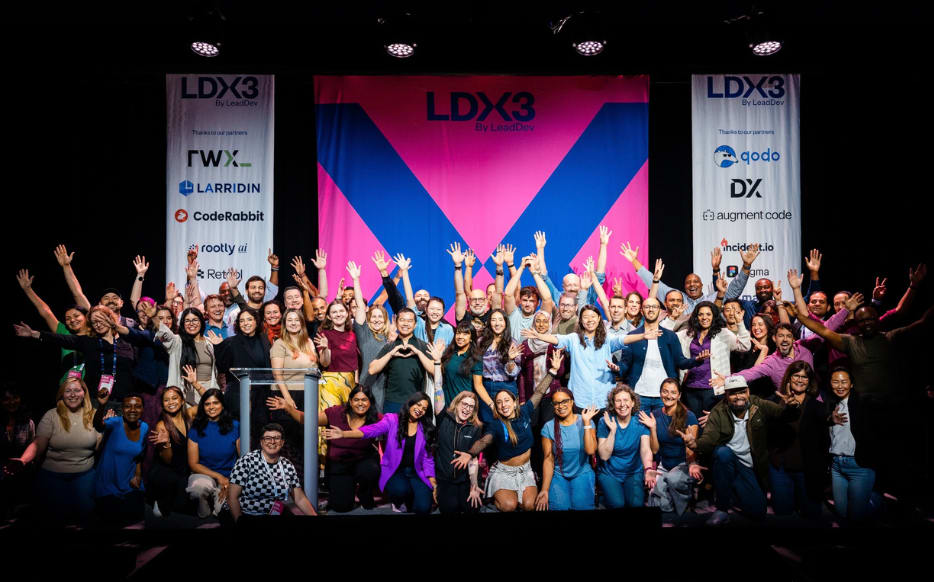
New York • September 8 & 9, 2027
Loved LDX3 New York? Pre-sale tickets for 2027 are now available.
The leverage has shifted
A May 2026 Gartner survey of 350 global business executives found that, among organizations piloting autonomous business capabilities, 80% report workforce reductions, yet they are not tracking a measurable impact on ROI at all. Gartner analysts also indicate agents create more work for humans, not less.
Add in rising AI platform costs, metered usage-based billing, and token price hikes, and we could see the opposite of human job cuts: limits on AI tooling use.
While AI agents expand a single engineer’s scope tremendously and shift expectations for entry-level positions, experts don’t say this equates to an elimination of work. Instead, it’s more like a net-positive talent redefinition as the barrier to generating code falls and software demand increases.
“Developers entering the field now will spend less time writing repetitive, formulaic code and more time learning how to work with agents effectively,” says Lloyd.
All in all, while layoffs are real, the headlines are noisy and shouldn’t be the sole signal. Instead, the broader shift is around how work is being redistributed, and the new AI agent and infrastructure roles emerging.
“AI doesn’t eliminate seats one-for-one,” adds Bevilacqua. “It shifts where the leverage sits.”

