
You have 1 article left to read this month before you need to register a free LeadDev.com account.
Estimated reading time: 4 minutes
Key takeaways:
- Shadow software lands on your team, with 60% of builders in Retool’s survey making something outside IT oversight last year.
- Give builders guardrails IT can see.
- Your developers feel the shift too with engineers worried about codebases nobody fully understands and about their jobs.
Putting AI-coding tools in the hands of experienced software developers can supercharge their productivity – even if it’s not necessarily as much as some of AI’s biggest backers have hoped. However, the consequence is that some of those without experience of developing software, or the things that ought to be known about how to do so well, are also able to spin up their own tooling.
Big companies like Ramp and Stripe have built internal AI tools that let employees who aren’t software engineers create their own applications using company data, with the former saying that, as part of onboarding new employees, the company encourages new hires to build an app as part of their process.
They’re not alone. Retool surveyed 817 people building software and found that 60% had created something outside IT oversight in the previous year, while 51% had built software with AI that was actually being used by their teams. Vibe coded products and projects can be enormous timesavers.
Your inbox, upgraded.
Receive weekly engineering insights to level up your leadership approach.
A blessing and a curse
“In recent months we’ve seen a rise in non-technical users building their own applications and agents with AI,” says Christina Troy, senior manager, IT at Tines.
Troy describes that as “an incredible opportunity for everyone to build the tools that they need exactly to spec, but [admits it] opens up a number of challenges with governance of this employee-built software.”
As Edona Elshan, assistant professor at the Vrije University of Amsterdam puts it, “people find a way to slip away from [compliance guidelines] and do something a bit in the shadows.”
Those vibe-coded projects materially change how a company operates, and what a software engineer does within the organization.
Developers become firefighters trying to fix hacked together apps and managing often competing pet projects as much as they are designing a cohesive whole for an organization.
“What happens a lot is that IT teams often only find out about the software and the connectors used when something breaks,” says Troy. That’s in part because employees are not just being given permission, but are actively encouraged to tinker in their own time. “In many organizations, teams are being encouraged to build but with no thought to how to run the software, who maintains it, and manages secure access to systems.”
Maintaining oversight
“There’s a worry among software developers about what is going to happen in the future because no one has oversight about anything,” says Elshan.
Organizations like Tines have come up with approaches that are designed to try and reduce that risk and ensure that any individual project can’t waylay an entire organization in the event that something goes wrong.
More like this
The firm has developed its own platform, Tines 3B, where employees can build software but – crucially – IT and security teams can oversee what’s going on. “We monitor what applications have access to which tools and data, we see where there is any duplication and we can get ahead of any security concerns,” says Troy.
It’s an approach that is designed to try and encourage that level of self-determination over what software is developed, while not sacrificing safety along the way.
“We believe that in this new era of employee building, every company will need a secure environment to run this software securely and at scale,” says Troy. “Employees need guardrails and frameworks within which to build, and IT teams need to have visibility from the outset of these builds.”
That’s particularly the case in the event that an employee who vibe codes a tool moves on from the business, but the tech they’ve built becomes integral to how the organization operates.
Such responsibility will likely fall to engineering teams that had no involvement in building the software in the first place and wouldn’t have made it as designed. It means that, instead of clearing their existing backlog, they end up inheriting an entirely new one.
Keeping morale high
Beyond safety, there’s also staff morale to consider. Traditionally, employees in departments like HR and marketing have relied on developers to create the tools they need. When AI tools are put into the hands of every employee, that changes.
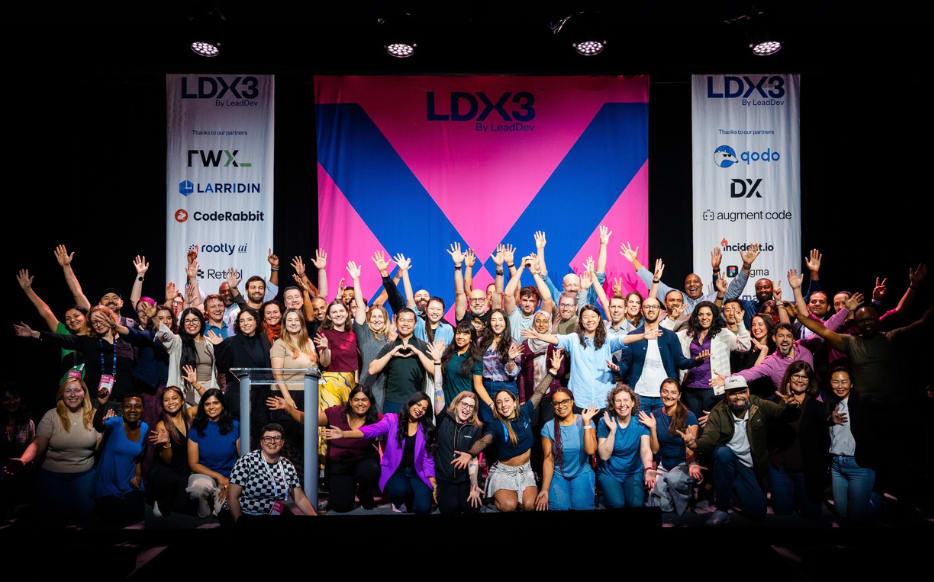
New York • September 8 & 9, 2027
Loved LDX3 New York? Pre-sale tickets for 2027 are now available.
That shift is already creating friction, Elshan’s research shows. Professional developers she speaks to are concerned about losing control of increasingly complex codebases that nobody fully understands – as well as worrying about their future employment.
“They’re switching from this role of just receiving from IT to taking things into their own hands,” Elshan says of rank and file employees – which comes with its own headaches.
“This is creating a lot of clashes.” It all adds up to a challenge for engineering managers beyond managing their code base – they also have to invest plenty of time in keeping their people happy, too.