
You have 1 article left to read this month before you need to register a free LeadDev.com account.
Estimated reading time: 5 minutes
Key takeaways:
- Engineers must move from using agents to building them… but most lack the skills.
- MCP adoption is outrunning governance: leaders need internal standards.
- Build on open standards and vet them for stability and neutral governance.
“Software development is going to transition into building more agentic systems,” predicts Angie Jones, VP at Agentic AI Foundation.
It’s a bold statement for the future of programming, but feels in line with the rapid progression from AI suggestions, to AI-coding assistants, and, now, to autonomous agents capable of conducting complex subtasks and workflows.
Naturally, engineers are still learning how to best use agents in their daily workflows, but that’s not the long game, says Jones. At the end of the day, someone has to design and build the thing that builds everything.
“They [engineers] are consumers of it. What we need is for engineers to become builders of it,” says Jones. “Whatever your business is, you’re likely, in the next couple of years, going to want to build some agentic capabilities within your products.”
Many are looking into agentic development, but it’s going to take engineering leadership to guide new agentic skills development, solve Model Context Protocol (MCP) governance issues, and ensure the organization is building on top of stable open foundations.
Your inbox, upgraded.
Receive weekly engineering insights to level up your leadership approach.
New skills required for agentic development
This new agentic reality sounds flashy. What does it mean to not just use an agent, but to build one? The reality is there are plenty of new skills that still need ironing out.
For instance, are engineers actually learning how to build agentic systems? Can they effectively manage nondeterministic systems and control what they can and can’t do? Can you observe the actions it’s taking, and, when something goes wrong, pull a trace and debug?
“I don’t see enough engineers picking up those skills,” says Jones. “Engineers and engineering leaders need to come together in a time like this and learn from one another.”
She adds that events and conferences have been incredibly important to get the community of folks building systems, frontier labs, senior engineers, and engineering leaders together to build that sort of knowledge.
“It’s not just people demoing flashy stuff or products – this is all about standards, protocols, open source projects, and real hard-fought lessons being shared.”
Governing MCP needs to happen too
Much of the recent growth and excitement around agents has relied on MCP, an AAIF-housed open standard for connecting agents with external data and tools.
“There’s a lot of conversations happening around MCP,” says Jones. “If you are a leader and you are looking into agentic systems, MCP is going to be something that your team needs to use, but also may need to build with.”
The sheer uptick in usage is worth noting here. At AGNTCon + MCPCon Europe in Amsterdam, David Soria Parra, co-creator of MCP and member of technical staff at Anthropic, shared that Claude has already served more than one billion MCP tool calls.
This isn’t even considering all the other AI platforms that have raced to support MCP. On ChatGPT, MCP tool calls reached 98x their January level by August 2026, says AAIF.
The quick adoption of MCP, and its usage within countless other platforms, means that leaders should take it seriously and really operationalize internal standards around MCP.
For Jones, simply downloading an MCP server off the internet isn’t the secure practice. Engineers need to consider how MCP servers should be governed and what additional control planes must be put in place.
More like this
Standards promote agentic interoperability
Coalescing around open standards avoids one party trying to own an entire ecosystem end-to-end. Standards promote a more interoperable, even playing field, which is becoming incredibly important for agentic systems.
For instance, take an agentic commerce scenario, in which agents are tasked with making shopping purchases. That would involve using various underlying protocols for conducting authorization, identification, allocating funds, and moving money.
As Jones shares, no one wants a single company, like a Visa or a Stripe, to own those standards for the entire payments industry. “That’s why the Agentic AI Foundation is here, to bring interested parties to the table so they can work on them together,” she says.
Similarly, take MCP. Many were happy when MCP joined the Agentic AI Foundation so that MCP had a stable home, governed by a neutral body, where others could contribute to it, as well as other AAIF projects, like Agents.MD and Goose.
“It’s not the Anthropic show anymore,” says Jones. “They’re still very heavily involved, but so are lots of other companies as well, and they can influence the roadmap too.”
More agents mean more standards required
“A lot of folks right now are using their one personal agent,” says Jones. “Eventually, you’ll have companies that start publishing agents as a service.”
Once you have many agents authorized to do certain tasks, you run into new problems around data access, delegating tasks, and coordinating inter-agent communication across entirely different businesses.
Jones points out that Agent2Agent protocol (A2A), another AAIF-hosted project, has emerged as an important vendor-neutral glue for helping determine how agents talk to one another within multi-agent systems.
Jones recently saw one example of this playing out at a conference in China, where differences between US and Chinese software development patterns were very apparent.
Many Chinese companies are building complete solutions or “super apps,” and she points to WeChat as an example. An agent within a super app might need to communicate with another agent outside its ecosystem, creating a clear use case for A2A.
“That seems futuristic for us in North America because I don’t think many people are there yet. Whereas in China, they use [A2A] pretty heavily.”
As the rest of the world edges toward agent and multi-agent development, underlying standards like MCP and A2A will likely have an even greater role in agentic systems at a broader scale.
For Jones, senior leaders should therefore be evaluating the standards they build upon, asking questions like “is this something that’s stable? Is it governed by a neutral body? Would I be safe building on top of something like this? Can I contribute back to it if we have certain needs and requirements?”
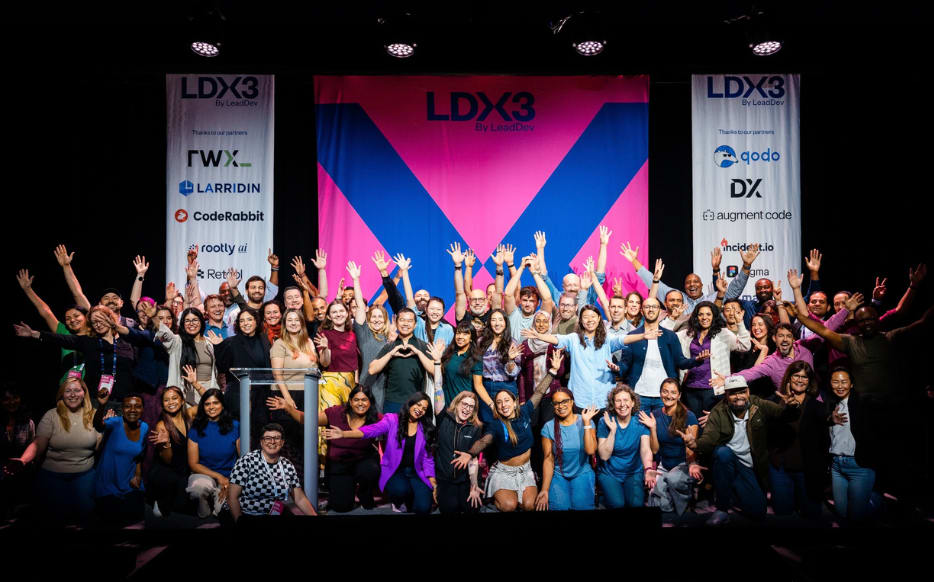
New York • September 8 & 9, 2027
Loved LDX3 New York? Pre-sale tickets for 2027 are now available.
From consumers to builders
“I feel like the future is being built right here,” says Jones… and it’s happening quickly.
The AAIF only launched in December 2025, yet interest in the initiative has been deafening. With 270 members, including founding members like Anthropic, OpenAI, and Block, as well as tech organizations like Google, AWS, Cloudflare, Bloomberg, and plenty of others, it’s well off to the races.
She encourages engineering leaders to not only consider how they can incorporate open source into their agentic systems development, but also to consider how their organization can contribute back to open source, join relevant working groups, and contribute to neutral initiatives.
As Jones says, “it is the season for building right now.”